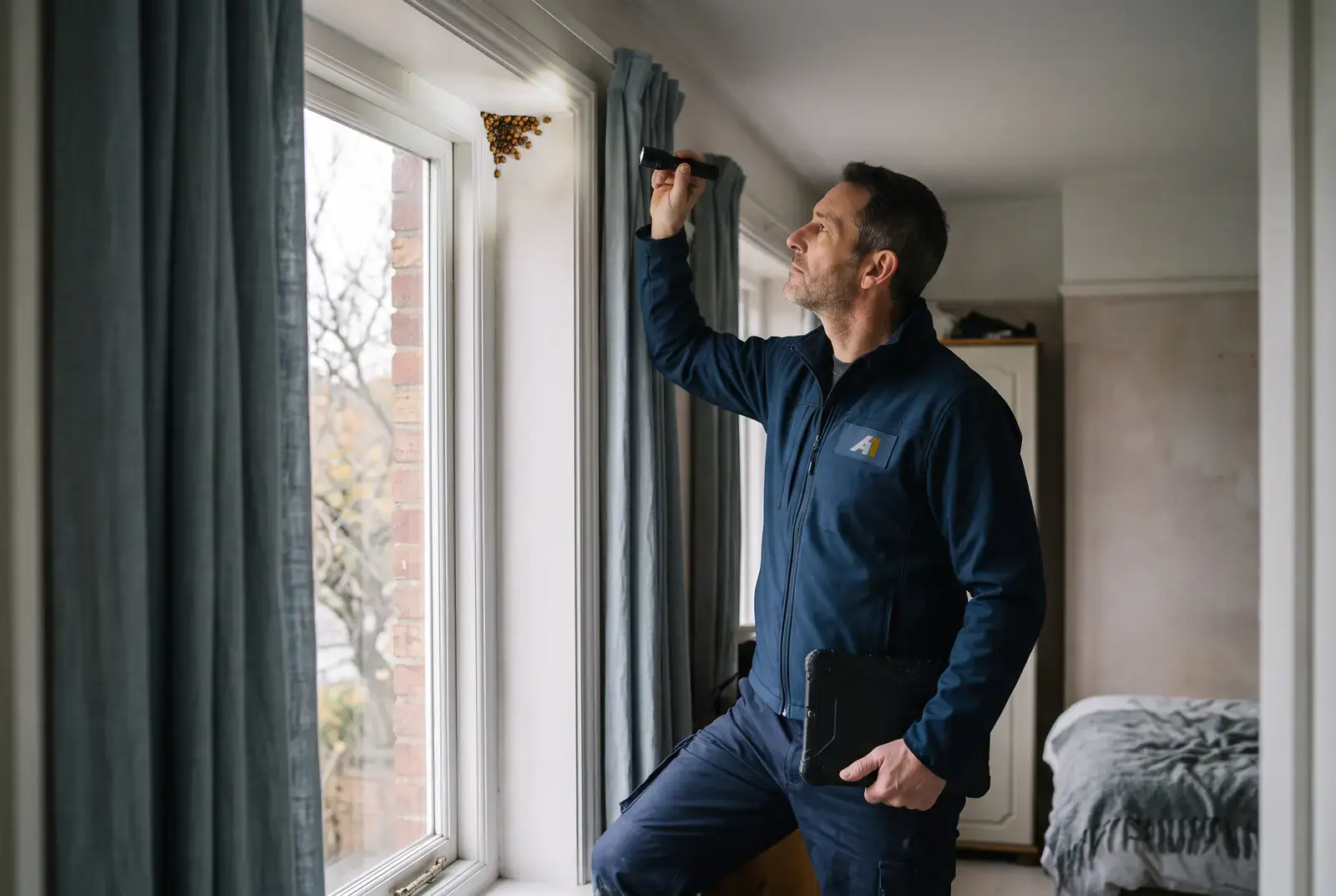
Ladybird removal in Hayling Island
Hayling Island, PO11, has ladybird removal from A1 Pest Control, starting from £190. In a 5 km radius of Hayling Island, 8 harlequin ladybird sightings stand on the NBN Atlas (accessed 11 November 2026), the first 2 of them from 2014. Somebody logged each ladybird; none stands for a household with a cluster. The Natural History Museum describes winter clusters of harlequins, with houses standing in for the caves and hollow trees they once sheltered in, and says they slip in round loose-fitting windows. Technicians deal with groups returning to the same window frames and loft corners each autumn, covering houses, flats and holiday lets across Hayling. Send a photo if you can, with which windows fill up and whether the group returns every year.
About Ladybirds
Ladybirds that crowd into window frames and lofts in autumn are often harlequin ladybirds, a non-native species first recorded in Britain in 2004. They do not damage buildings, but they smell and can stain fabrics when disturbed. A1 Pest Control deals with large groups that come back to homes and businesses each year.
Read the full Ladybirds guideLocal notes for Hayling Island
Harlequin records after the 2014 pair stand at 1 each in 2015, 2016, 2017, 2018 and 2019, plus 1 so far in 2026. One names Northney Common. Ladybirds of every species number 61 records within 5 km, 10 of them dated 1985, and the years from 2014 to 2026 give 3, 9, 3, 1, 3, 7, 3, 2, 4, 1, 4, 1 and 2. Northney Common and Sinah Common are named 3 times each.
According to the RHS, the harlequin arrived in Britain without a deliberate introduction and is most widespread in England. Everything else we treat is listed on our Hayling Island pest control page.
Local risk in Hayling Island
Where groups settle
Window frames, loft hatches and curtain folds are the spots to check first, since the RHS lists buildings among the sheltered places where adults overwinter in large groups.
Telling them apart
At 8 to 10 mm a harlequin is larger than the native two-spot and ten-spot ladybirds, which are only 4 to 5 mm long, so size is the first clue.
Life cycle
Eggs are laid on plants that carry aphids, and adults feed mainly on aphids. The larvae are spiky and charcoal grey with two orange stripes, and they pupate after two to three weeks. Pupae are dark with orange or red markings, and warm weather allows several generations a year.
- Photograph a group beside a coin for scale.
- Release a group outdoors after brushing it into a lidded tub.
- Seal gaps round loose window frames.
- Check caravans and holiday lets before they close for winter.
The species are shown side by side in our ladybird removal guide.
Price and visit times
Havant Borough Council does not include ladybirds in the pests it treats. A group at the windows of a house, caravan or let on the island is a private booking. To book for ladybirds, ring A1 on 0800 059 0135.
Starting from £190
Not sure what you have found? Send us a photo first. Evening and weekend visits are available on request, and a weekend visit costs £60 extra.
Request a callCustomer reviews in Hayling Island
Google rating: 5.0 from 6 reviews.