Pest guide
Ladybirds: signs, treatment and prevention
Harlequin ladybirds wintering in window frames.
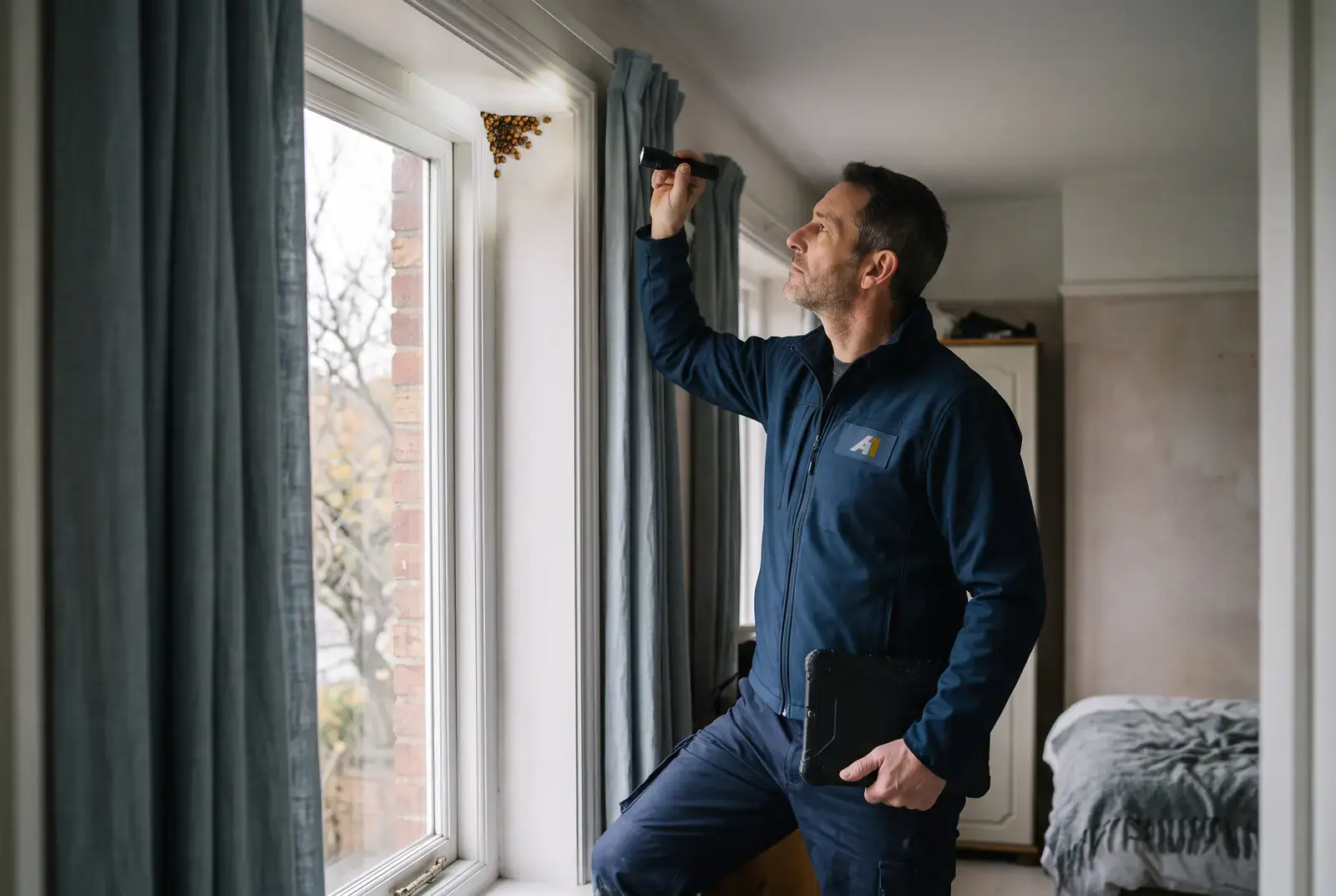
Ladybirds that crowd into window frames and lofts in autumn are often harlequin ladybirds, a non-native species first recorded in Britain in 2004. They do not damage buildings, but they smell and can stain fabrics when disturbed. A1 Pest Control deals with large groups that come back to homes and businesses each year.
What signs should I look for?
Ladybirds gather when the weather cools in autumn, looking for a dry crack to sleep in until spring.
- Groups at windows in autumn: clusters on the sunny south side of the building, then on the inside of windows, around loose window and door frames, in shed corners and in lofts.
- Ladybirds walking about in winter: on mild days through the winter, some wake up and wander around rooms.
- Yellow stains: small yellow marks on curtains, sills and soft furnishings where disturbed ladybirds have released fluid.
- A musty smell: the same fluid smells, though ladybird expert Professor Helen Roy says the smell is slight and does not travel far.
- Spiky larvae outside: in spring and summer, charcoal grey larvae with two orange stripes, up to about 1 cm long, on garden plants.
Is it a harlequin?
Harlequins are usually larger than native ladybirds, around 5 to 10 mm, and come in many patterns. The two most common are black with two red spots, and orange with up to 19 black spots. Look at the pale shield behind the head: on a harlequin it often carries black marks in the shape of an M, and the legs are usually orange brown. The RHS warns it is often hard to be sure, because native 2-spot and 10-spot ladybirds also vary.
Why are they a problem?
Harlequin ladybirds do no damage to the building, BPCA says, and the RHS says there is no danger in having them indoors. The problems are the numbers, the stains and the smell, and what harlequins do to native ladybirds.
Stains and smell
A disturbed ladybird releases a yellow fluid, called reflex bleeding, which puts predators off. It smells and can stain curtains, carpets and pale furnishings. Professor Roy thinks vacuuming a group makes the smell worse, so a soft brush and a container can be the better choice.
Do they bite?
You may read that harlequins bite. Professor Roy says the risk is greatly exaggerated: in decades of handling ladybirds she has had one bite, from a native 7-spot, and it was very minor. Allergic reactions to harlequins have been reported, but she knows of only two or three cases.
A threat to native ladybirds
Harlequins were never deliberately released in Britain and were first recorded in Essex in 2004. As well as aphids, they eat the eggs and larvae of other ladybirds and the eggs of butterflies and moths. One study found harlequins made up as much as 70% of the ladybirds on lime trees, while the native 2-spot declined. The RHS says the evidence on native species is mixed and research is still going on.
How do we get rid of them?
The RHS says there is no way to control harlequins without also harming native ladybirds and other insects, so treatment aims to get them out of the rooms and stop them getting back in. A typical approach:
- Identify them. Native 2-spot and 7-spot ladybirds also spend the winter in buildings, sometimes in the same group, so the technician checks what you have before killing anything.
- Remove the groups. The technician vacuums the clusters, or brushes them into a container to release outdoors on a mild day.
- Treat the gaps. For a heavy infestation, BPCA guidance is a residual insecticide on the cracks and gaps where ladybirds get in and settle. It also kills any native ladybirds sheltering there.
- Proof the building. Sealing gaps around loose windows, doors and frames means fewer get in next autumn.
Homes and business premises
For homes
A few ladybirds in a window over winter are best left alone or put outside. Call us when they come back in large numbers every autumn, stain curtains and furnishings, or keep turning up in bedrooms and living rooms on mild days. Ladybird treatment costs between £190 and £240, depending on the property.
For businesses
Ladybirds gather in any building with gaps around its windows, and the yellow stains they leave on curtains and furnishings are a problem in guest rooms, holiday lets and offices. We treat and proof the affected rooms. See retail and hospitality and commercial pest control.
How do I stop them coming back?
- Seal gaps around window frames and doors before autumn, especially on the south side of the building.
- Repair loose window frames, where ladybirds squeeze in at the edges.
- Brush or vacuum groups into a container as soon as they appear, before they settle for the winter.
- Leave leaf litter and hollow plant stems in the garden, which give native ladybirds somewhere to spend the winter outside.
How much does treatment cost?
Ladybird treatment costs between £190 and £240, depending on the property. A revisit costs £150. Weekend visits cost £60 extra.
Your questions, answered.
Why are there ladybirds in my house?
As the weather cools in autumn, ladybirds look for a dry crack to sleep through the winter. Window frames, door frames, sheds and lofts suit them, and they gather first on the sunny south side of buildings. In spring they leave to mate and lay their eggs on garden plants where there are aphids.
What do harlequin ladybirds do indoors?
A disturbed ladybird releases a smelly yellow fluid that can stain curtains and furnishings. Bites are rare and minor, and allergic reactions have been reported but are very uncommon.
Do ladybirds bite?
Rarely. You may read that harlequins bite more than native ladybirds, but ladybird expert Professor Helen Roy says the risk is greatly exaggerated. In decades of handling ladybirds she has had one bite, from a native 7-spot, and it was very minor. If a bite is painful or swells, a pharmacist can advise.
Are ladybirds protected in the UK?
No ladybird beetle is listed as a protected animal under the Wildlife and Countryside Act 1981. The only ladybird on the list is the ladybird spider, a rare spider. Native ladybirds are still worth keeping, and they often share winter sites with harlequins, so check what you have before using any insecticide.
How do I get rid of ladybirds in my house?
Brush or vacuum small groups into a container and put them outside on a mild day. Seal gaps around loose windows and doors to stop more getting in. For a large group that comes back every year, a professional can treat the gaps where they settle, though this also kills any native ladybirds there.
How can I tell a harlequin from a native ladybird?
Harlequins are usually larger, around 5 to 10 mm, and come in many patterns, most often black with two red spots or orange with many black spots. The pale shield behind the head often has black marks in an M shape, and the legs are usually orange brown. A native 7-spot has red wing cases with seven black spots.
Tell us what's happening.
Share your postcode and the signs you have noticed.