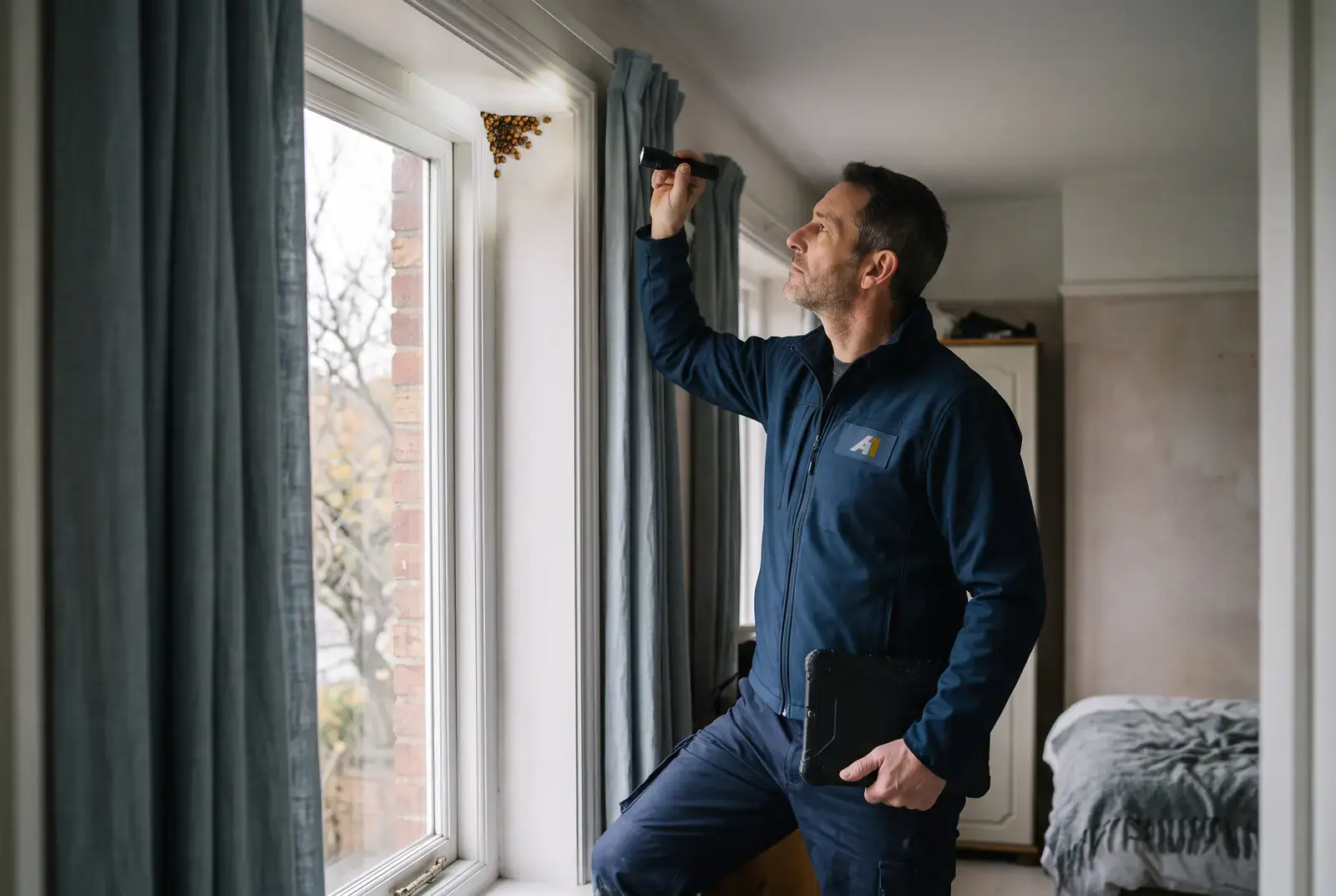
Ladybird removal in Portsmouth
A1 Pest Control offers ladybird removal in Portsmouth, covering PO1, PO2, PO3, PO4, PO5 and PO6, starting from £190. Within 5 km of Portsmouth, the NBN Atlas, accessed 11 November 2026, holds 125 harlequin ladybird sightings, the first in 2005 and a peak of 25 in 2007; each is a ladybird somebody logged, not a household with a cluster. The Natural History Museum says harlequins hibernate together in clusters, and that homes have replaced the caves and hollow trees they once used. Large groups returning to the same windows and loft corners each autumn are the ones we deal with. Our technicians cover houses, flats and shops across Portsmouth. Does the group fill the same windows and return every autumn?
About Ladybirds
Ladybirds that crowd into window frames and lofts in autumn are often harlequin ladybirds, a non-native species first recorded in Britain in 2004. They do not damage buildings, but they smell and can stain fabrics when disturbed. A1 Pest Control deals with large groups that come back to homes and businesses each year.
Read the full Ladybirds guideLocal notes for Portsmouth
In 2005 the first record came to 2 sightings, and the counts that followed the 2007 peak eased to 12 and 13 a year in 2013 and 2014, then 7 in 2017, 7 in 2018, 6 in 2019 and 2 in 2020. The latest counts are 2 in 2024, 3 in 2025 and 2 so far in 2026. The records that name a public place give Victoria Park, Milton Common, Portsdown Hill and Southsea, one each.
Only a year behind the harlequin’s establishment in Britain in 2004, according to the Royal Horticultural Society, came the first Portsmouth record. Everything else we treat appears on our Portsmouth pest control page.
Local risk in Portsmouth
How they get in
The museum says harlequins usually enter through gaps around loose-fitting windows. Adults are 8 to 10 mm long and come in many forms, the commonest black with two red spots or orange with 18 black spots, so a group at a window is often a mix of patterns.
Stains
A clear yellow liquid left by a disturbed beetle may stain furnishings.
South-facing walls
The RHS says adults gather in autumn on the south side of buildings, so those windows are the first to fill.
Several generations
Adults emerge in spring, mate and lay eggs on plants that carry aphids, and the spiky larvae pupate after two to three weeks.
- Check window frames and the loft hatch edge in October.
- Seal gaps where loose frames meet the wall.
- Have a photograph of the group ready when you ring.
For a side-by-side look at the species, open our ladybird removal guide.
Price and visit times
Starting from £190
Not sure what you have found? Send us a photo first. Evening and weekend visits are available on request, and a weekend visit costs £60 extra.
Request a callCustomer reviews in Portsmouth
Google rating: 5.0 from 6 reviews.