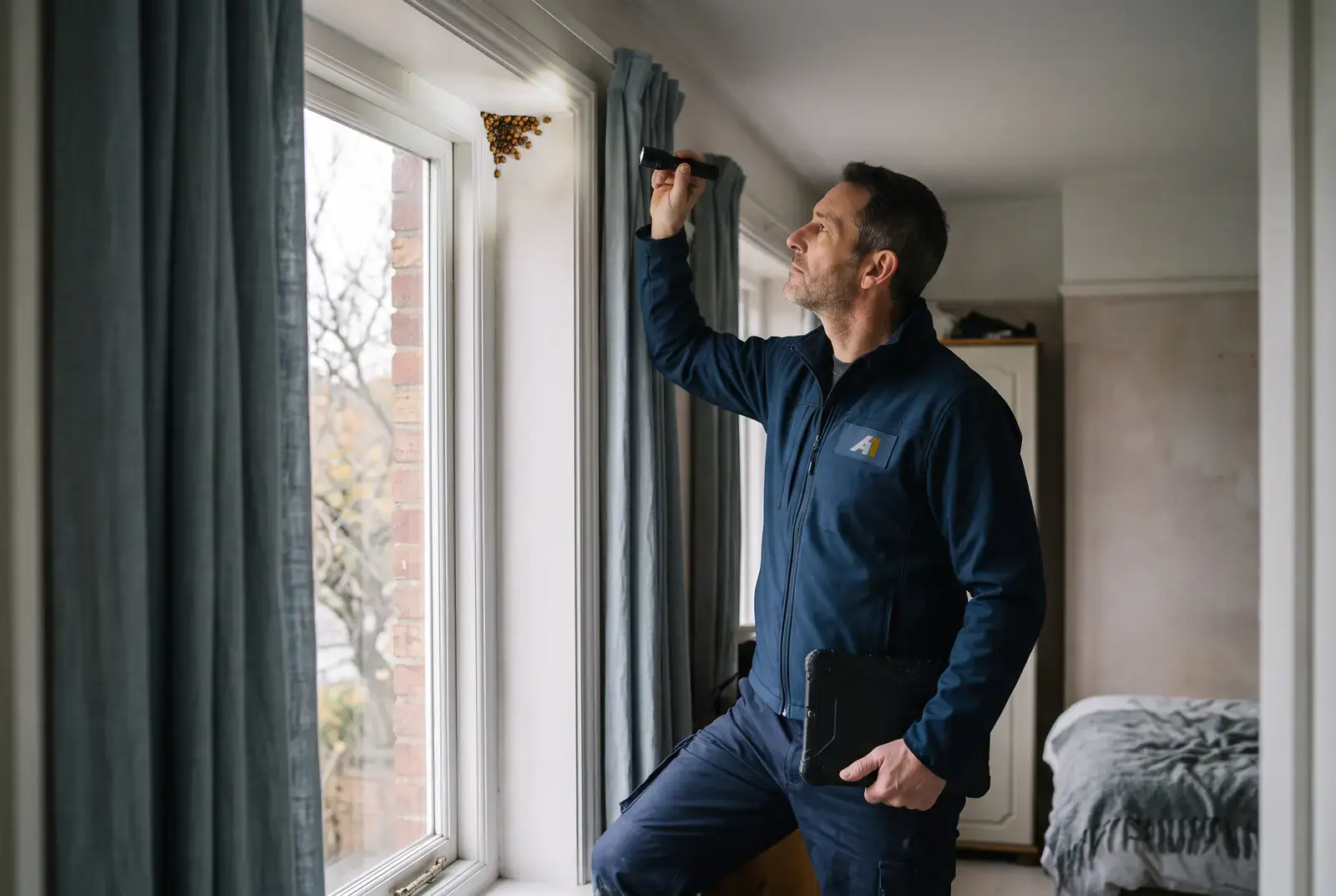
Ladybird removal in Farnham
The NBN Atlas, accessed 12 November 2026, holds 124 recorded harlequin ladybird sightings within 5 km of Farnham. The first local ones date from 2006, when 15 were logged, and 2007 has the most of any year, 21. October is the busiest month, with 29, as groups look for somewhere dry to spend the winter. A cluster that is disturbed gives off a smelly yellow liquid that can mark fabric. A1 Pest Control clears clusters from window frames, lofts and sheds. Technicians cover homes and businesses across Farnham. Call 0800 059 0135 and tell us where the ladybirds gather and roughly how many there are.
About Ladybirds
Ladybirds that crowd into window frames and lofts in autumn are often harlequin ladybirds, a non-native species first recorded in Britain in 2004. They do not damage buildings, but they smell and can stain fabrics when disturbed. A1 Pest Control deals with large groups that come back to homes and businesses each year.
Read the full Ladybirds guideLocal notes for Farnham
Harlequin records in the Farnham circle name the village of Badshot Lea in 5, Rowledge in 4 and Alice Holt Forest in 2. Other busy years were 2008 with 16, 2016 with 12 and 2025 with 10, and 6 have been logged so far in 2026. These are recorded sightings, not infestation levels. Native ladybirds are far scarcer around Farnham, with 18 two-spot records, the latest from 2026, and 8 ten-spot, 2 of them from 2025. Harlequins outnumber the two natives together by more than four to one. See the Farnham pest control hub for the full list of pests.
Local risk in Farnham
Why October
October is the busiest month in Farnham’s records, with 29 of the 124 sightings, as groups look for somewhere dry to spend the winter. In the Royal Horticultural Society’s account, harlequins cluster in sheltered places for the winter, often inside buildings, and on a mild winter day a few wake and walk about the room.
Some smell
A large cluster of harlequins indoors smells, according to the RHS. Ladybird researcher Professor Helen Roy’s advice is on our ladybird page.
Harlequin or native
Harlequins and native ladybirds are easy to confuse. The RHS suggests checking the pale area just behind the head, and the native two-spot and ten-spot come in many colour forms of their own.
- Photograph a cluster and note the room and window.
- Fill gaps at frames, soffits and loft hatches.
- Look over the loft and the shed each autumn.
- Note which rooms and windows the clusters return to.
Price and visit times
Starting from £190
Not sure what you have found? Send us a photo first. Evening and weekend visits are available on request, and a weekend visit costs £60 extra.
Request a callCustomer reviews in Farnham
Google rating: 5.0 from 6 reviews.