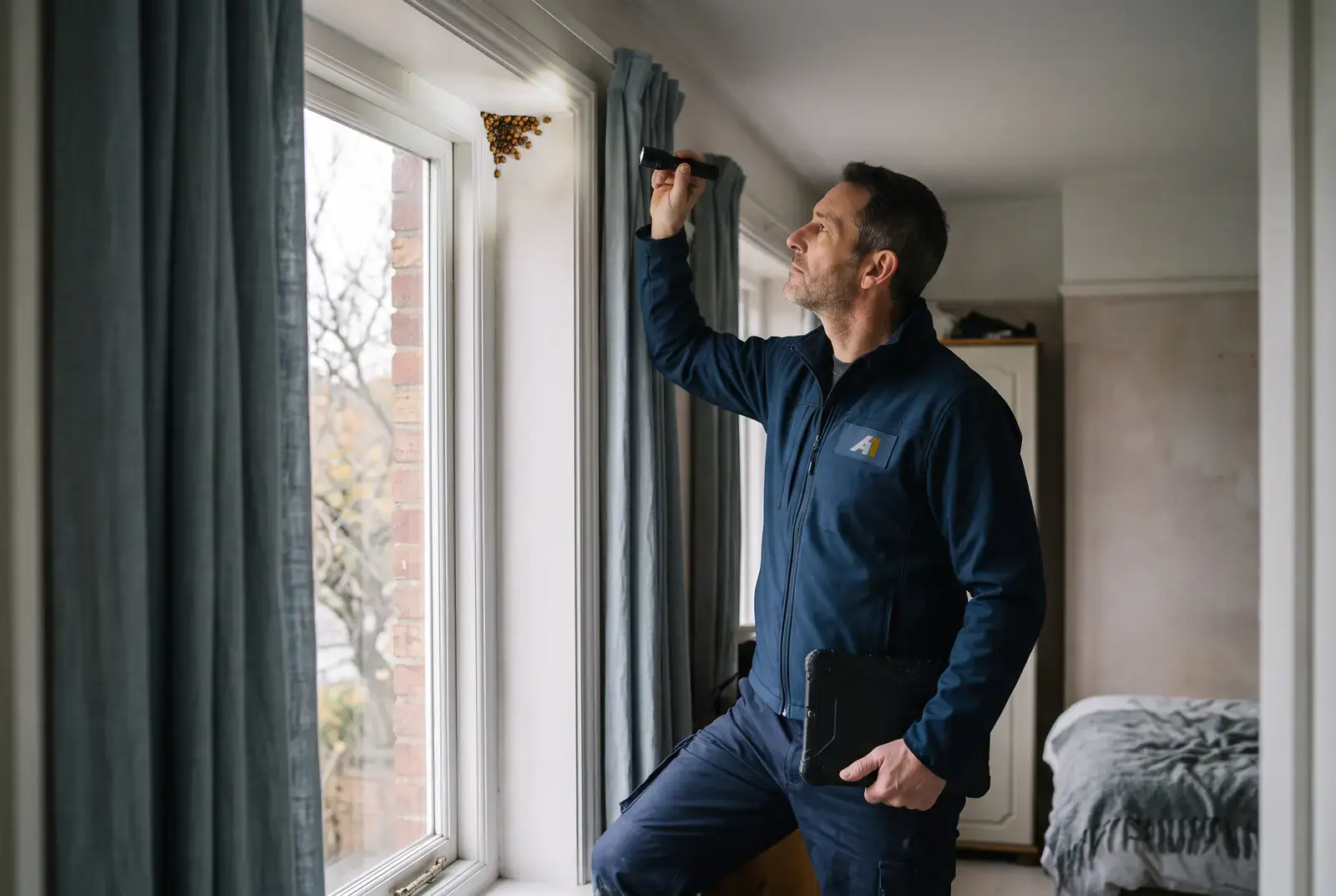
Ladybird removal in Bordon
The NBN Atlas, accessed 10 November 2026, holds 48 recorded harlequin ladybird sightings within 5 km of Bordon, the latest from 2026. Harlequins are a non-native ladybird first recorded in Britain in 2004, and the RHS says they gather in autumn to overwinter in buildings, often on sunny walls and around window frames. They do no damage to the building, but disturbed ladybirds leave yellow stains and a smell. A1 Pest Control deals with large groups that return each year to homes and businesses. We cover Bordon and Lindford. Tell us which windows or rooms they gather in, and when they started, and we will say what treatment involves.
About Ladybirds
Ladybirds that crowd into window frames and lofts in autumn are often harlequin ladybirds, a non-native species first recorded in Britain in 2004. They do not damage buildings, but they smell and can stain fabrics when disturbed. A1 Pest Control deals with large groups that come back to homes and businesses each year.
Read the full Ladybirds guideLocal notes for Bordon
Broxhead and Kingsley Commons lie north of Lindford: 105.1 ha of heath, acid grassland, woodland and scrub, with Woolmer Forest’s 1,298.5 ha of heath and woodland close by. The Hogmoor Inclosure adds 54 ha of green space. Homes along that edge sit between large areas of the wild ground where ladybirds feed through summer.
The records fall in the same places. Headley has the most named sightings, then Kingsley and Broxhead Common. In autumn, ladybirds leave that open ground to find a dry crack indoors. For every other pest we cover, see the Bordon pest control hub.
Local risk in Bordon
Is it a harlequin
Harlequins are usually larger than native ladybirds, around 5 to 10 mm, and come in many patterns. The RHS warns it can be hard to be sure, because native 2-spot and 10-spot ladybirds also vary.
Timing
Groups gather as the weather cools in autumn and look for a dry crack to sleep in until spring. Spiky, charcoal-grey larvae on garden plants in spring and summer are young harlequins, not a new pest indoors.
What they do indoors
Groups crowd into window frames, loft spaces and shed corners from autumn. On mild winter days some wake up and wander about rooms. Disturbed ladybirds release a yellow fluid that stains curtains, sills and soft furnishings.
- Close gaps around windows and doors before October.
- Collect stragglers with a soft brush and move them outside.
- Tell us where the group sits and how many you see.
Our ladybird page explains how to tell a harlequin from a native species.
Price and visit times
East Hampshire District Council no longer provides a pest control service, and its pest advice page does not mention ladybirds. Ladybird groups at a home or business are a job for a private firm. A1 takes ladybird calls on 0800 059 0135.
Starting from £190
Not sure what you have found? Send us a photo first. Evening and weekend visits are available on request, and a weekend visit costs £60 extra.
Request a callCustomer reviews in Bordon
Google rating: 5.0 from 6 reviews.