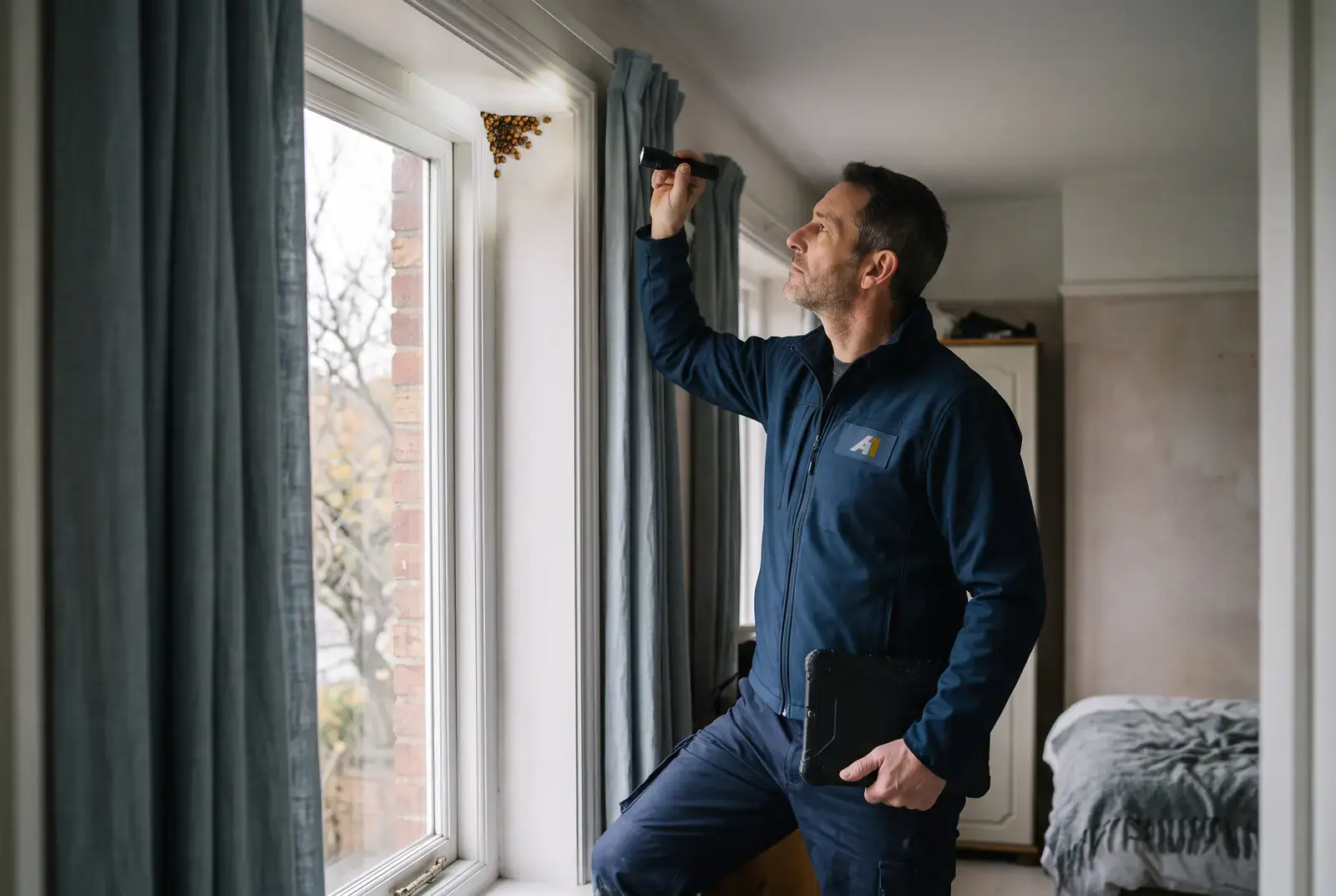
Ladybird removal in Worthing
Harlequin ladybirds, a non-native species, reached Britain’s records in 2004, and the NBN Atlas, accessed 11 November 2026, shows Worthing’s first two records that same year. The count reached 13 in 2006 and 45 in 2007, the peak, and stood at 7 in 2025. The total within 5 km is 142 recorded harlequin sightings. In autumn they pack into window frames, loft corners and sunny walls, and a disturbed ladybird leaves yellow stains on curtains and sills. A1 Pest Control handles the groups that return to the same windows every year. Technicians cover the whole of Worthing. Tell us which rooms and windows they gather at each autumn and winter.
About Ladybirds
Ladybirds that crowd into window frames and lofts in autumn are often harlequin ladybirds, a non-native species first recorded in Britain in 2004. They do not damage buildings, but they smell and can stain fabrics when disturbed. A1 Pest Control deals with large groups that come back to homes and businesses each year.
Read the full Ladybirds guideLocal notes for Worthing
These are sightings on record, not a measure of how many ladybirds sit in any one house. June has the most records with 27. The sightings come from Worthing, Durrington and Patching. Yearly counts were 12 in 2016, 5 each in 2017 and 2020, 4 in 2023, and 4 so far in 2026. The RHS says harlequins disperse in spring to lay eggs on plants with aphids, and the larvae, charcoal grey with two orange stripes and up to about 1 cm long, eat aphids on garden plants. The local hub page lists the other things we treat in town.
Local risk in Worthing
Why they gather
As autumn cools they seek a dry gap to spend the winter. First they cluster on sunny walls, then they work behind window and door frames, into shed corners and up to the loft. On mild winter days some wake and wander about the rooms.
Stains and smell
A disturbed harlequin releases a yellow fluid that stains fabric and smells. Professor Helen Roy, an expert on ladybirds, thinks vacuuming a group worsens the smell, so a brush and a container serve better.
Telling them apart
Harlequins run 5 to 10 mm and vary in pattern. Look for black marks forming an M on the pale shield behind the head.
- Seal gaps around frames before autumn.
- Brush clusters into a container.
- Do not crush them on curtains.
Our ladybird infestation guide shows the colour forms.
Price and visit times
Harlequin ladybirds are not treated by Worthing Borough Council, and the joint Adur and Worthing page says it runs no pest control service. A tenant whose windows fill with ladybirds each autumn should mention it to the landlord or agent. A1 takes bookings for Worthing homes on 0800 059 0135.
Starting from £190
Not sure what you have found? Send us a photo first. Evening and weekend visits are available on request, and a weekend visit costs £60 extra.
Request a callCustomer reviews in Worthing
Google rating: 5.0 from 6 reviews.