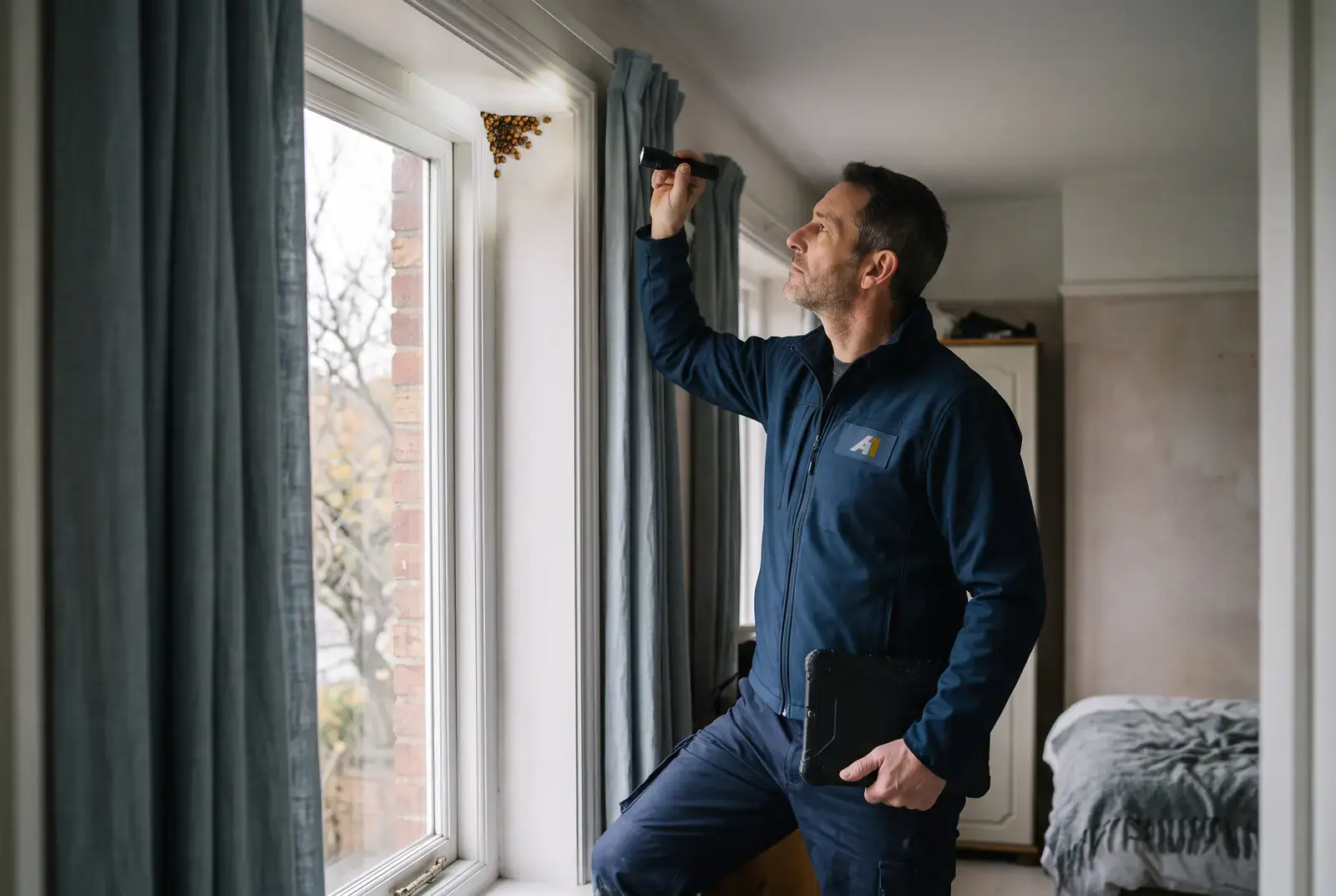
Ladybird removal in Southwick
Harlequin ladybirds arrived in Britain in 2004, the Royal Horticultural Society says, and the NBN Atlas, accessed 11 November 2026, holds 72 recorded harlequin sightings within 2 km of Southwick. The first came in 2006, with 21 that year and 22 in 2007. The RHS says that harlequins, like many ladybird species, spend the winter in groups indoors. It adds that the insects can exude a clear yellow liquid that stains furnishings, and that their main food is aphids. A1 Pest Control can attend homes and offices with ladybird clusters. Technicians cover BN42 in Southwick. Say which windows collect them, and when the first arrived.
About Ladybirds
Ladybirds that crowd into window frames and lofts in autumn are often harlequin ladybirds, a non-native species first recorded in Britain in 2004. They do not damage buildings, but they smell and can stain fabrics when disturbed. A1 Pest Control deals with large groups that come back to homes and businesses each year.
Read the full Ladybirds guideLocal notes for Southwick
After the early peak, the 2 km count fell to 10 in 2008 and 5 in 2009 and 2010, and it has stayed at 4 or fewer a year in the records since. The 5 km circle holds 121, and October is its busiest month, with 32. One of those records names Southwick Hill. The first record in the 5 km circle is also from 2006, and its yearly counts include 15 in 2014 and 6 in 2020. Those are ladybirds spotted, not a count of the ones behind your own windows. For the other pests we cover in town, see the Southwick hub.
Local risk in Southwick
Winter groups
The RHS says it is not possible to discourage harlequins from entering buildings, and that they can be captured and removed or tolerated. The RHS describes the harlequin as one of about 40 ladybird species in Britain and Ireland.
What they eat
Harlequins also eat scale insects, the eggs and larvae of butterflies and moths, and other ladybirds, and they can be cannibalistic. The RHS says evidence that they push out native species is mixed.
Telling them apart
Adult harlequins are 8 to 10 mm long. The two commonest colourings are red-spotted black and black-spotted orange, with 18 spots. Smaller native species, the two-spot among them, measure 4 to 5 mm. Harlequin larvae are charcoal grey, spiky and marked with two orange stripes.
- Shut sunny windows on warm autumn afternoons.
- Fill gaps round frames and eaves before the weather turns.
- Scoop clusters into a tub and release them outside.
The ladybird page shows the colour forms.
Price and visit times
The Adur and Worthing councils treat no pests. A ladybird cluster in Southwick is a private matter whether the home is owned or rented, and Adur Homes handles shared areas alone. For ladybird work, call A1 on 0800 059 0135.
Starting from £190
Not sure what you have found? Send us a photo first. Evening and weekend visits are available on request, and a weekend visit costs £60 extra.
Request a callCustomer reviews in Southwick
Google rating: 5.0 from 6 reviews.