Ladybird removal in Littlehampton
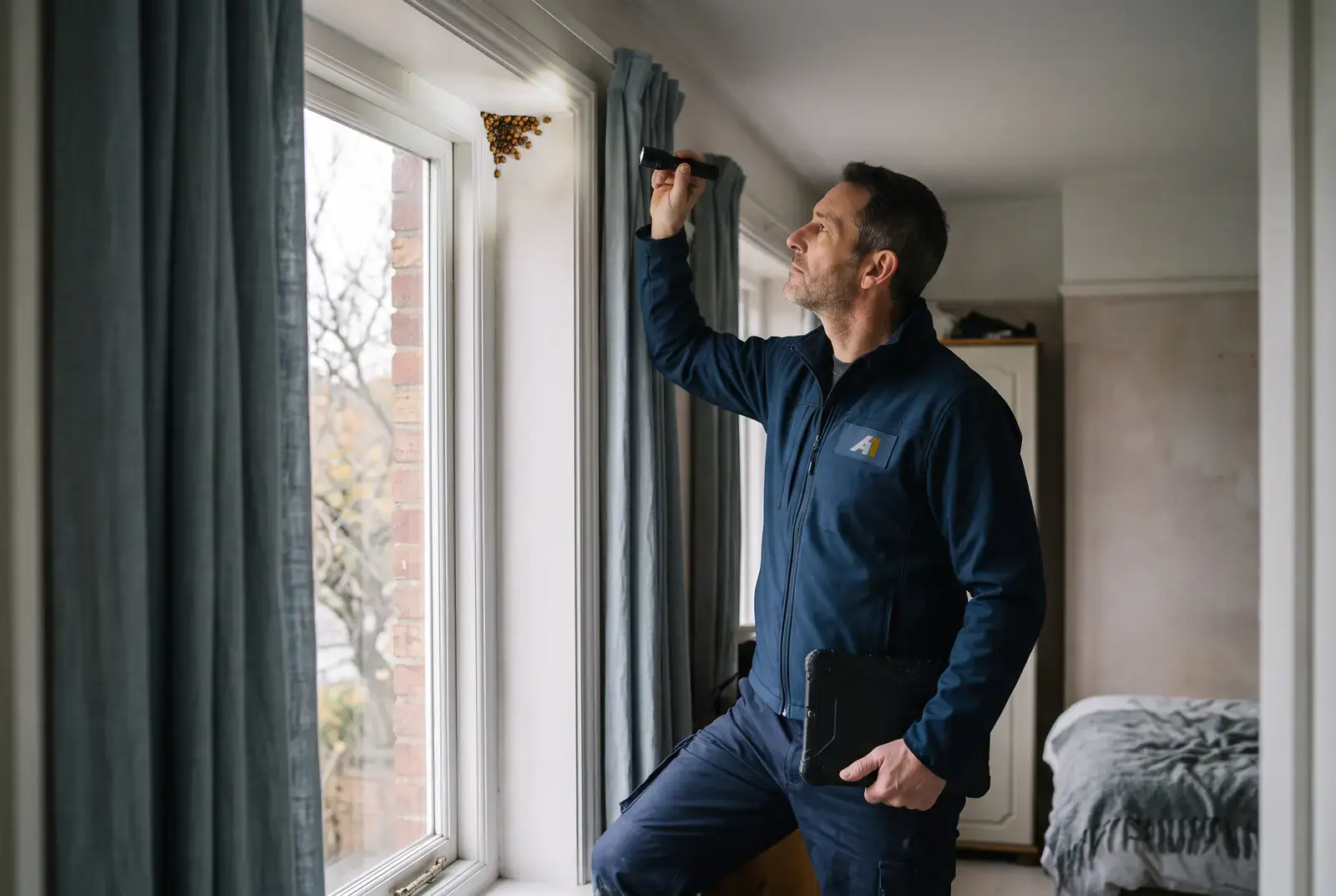
Harlequin ladybird sightings within 5 km of Littlehampton jumped from 3 in 2025 to 37 in 2026, according to the NBN Atlas, accessed 11 November 2026, and 35 of those 37 name Littlehampton itself. August holds 18. The only earlier surge came in 2006 and 2007. The Royal Horticultural Society says harlequins overwinter in groups, often inside buildings, and that adults measure 8 to 10 mm, ranging from orange with 18 black spots to black with two red ones. A1 Pest Control can remove groups that settle at windows and in loft corners. Our technicians visit homes, shops and offices across Littlehampton. Tell us which windows they gather at.
About Ladybirds
Ladybirds that crowd into window frames and lofts in autumn are often harlequin ladybirds, a non-native species first recorded in Britain in 2004. They do not damage buildings, but they smell and can stain fabrics when disturbed. A1 Pest Control deals with large groups that come back to homes and businesses each year.
Read the full Ladybirds guideLocal notes for Littlehampton
That surge brought 21 sightings in 2006 and 24 in 2007, the first years the area logged. Between the two surges the counts were small: 4 in 2008, 7 in 2009, 4 in 2013, 6 in 2014 and 9 in 2015. From 2017 to 2025 no year passed 3: 3 in 2017, 2 in 2018, 1 in 2019 and in 2020, 2 in 2022, 1 in 2023, and 3 in 2024 and in 2025.
That makes 2026 the largest single year in the log. These are sightings, not counts of buildings with ladybirds, and 2026 is not over. Browse the other local pests from the town hub.
Local risk in Littlehampton
Why they come in
After overwintering, the RHS says, harlequins disperse in spring to lay eggs on plants with aphids. Larvae are black and orange, spiky and up to about 1 cm long, and they eat aphids.
No outdoor control
The society says there is no way to control harlequins outdoors, since any action would harm native ladybirds and other aphid eaters, and that the species is now too abundant for local removal to change numbers. Indoors, groups can be tolerated or caught and released outside.
Handling
A disturbed ladybird can release a clear yellow liquid that stains furnishings, so lift groups with a soft brush and not your fingers. The RHS says the species is not dangerous.
- Check roller blinds and curtain pelmets.
- Look along loft eaves on sunny walls.
- Photograph a group before moving it.
- Look at south-facing windows first.
- Drape a cloth over curtains first, then move the group.
Our ladybird guide compares the colour forms.
Price and visit times
Arun District Council does not treat ladybirds. A winter group in a Littlehampton flat, shop or loft is therefore a private booking, and A1 takes calls on 0800 059 0135.
Starting from £190
Not sure what you have found? Send us a photo first. Evening and weekend visits are available on request, and a weekend visit costs £60 extra.
Request a callCustomer reviews in Littlehampton
Google rating: 5.0 from 6 reviews.