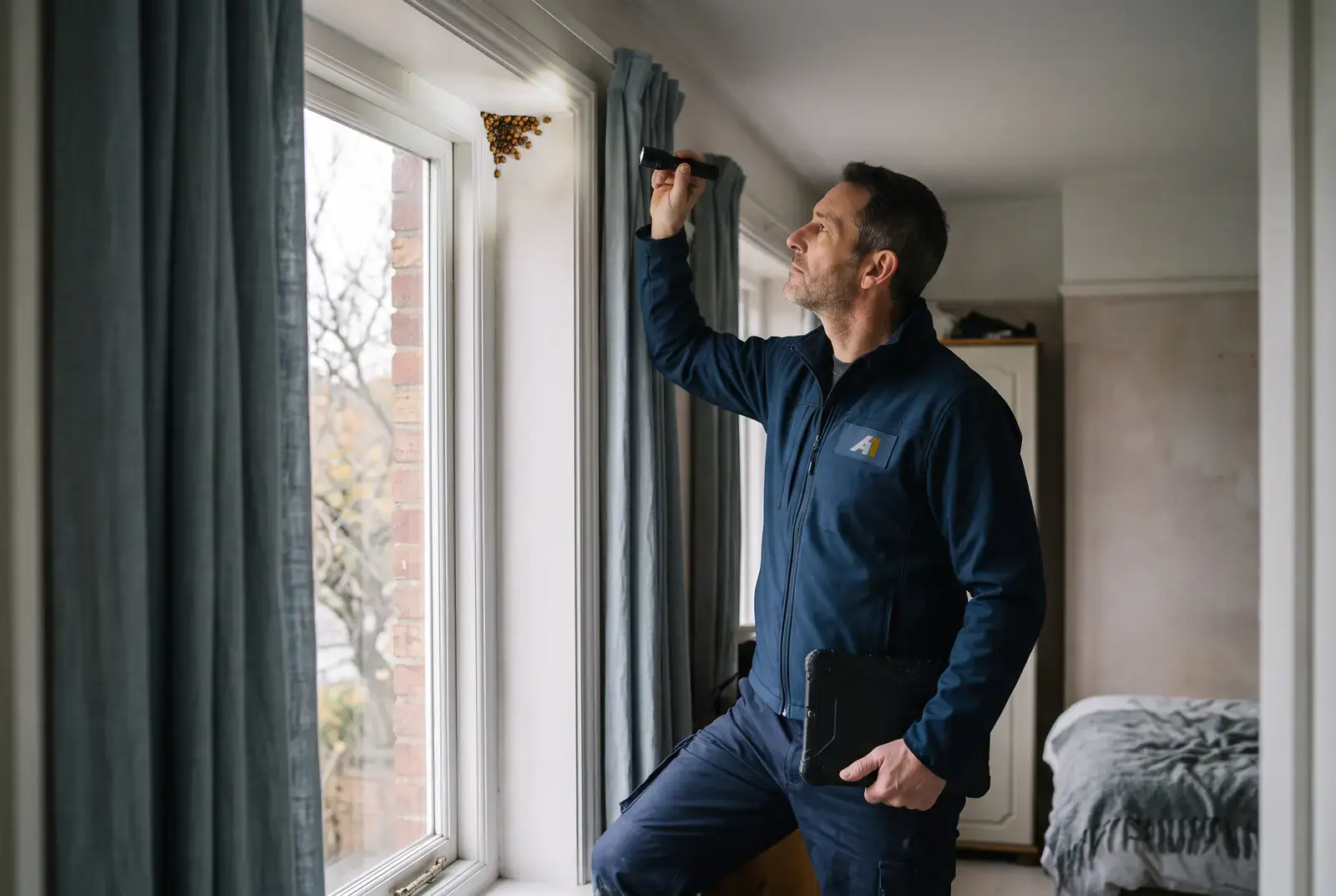
Ladybird removal in Totton
Totton’s 5 km circle holds 101 harlequin ladybird sightings on the NBN Atlas (accessed 12 November 2026). The earliest is from 2006, and 2007 was the busiest early year, with 25. The count then dropped to 4 or 5 a year until a jump to 20 in 2026. Clusters on a sunny window in autumn are the usual sign; the Royal Horticultural Society gives the adult length as 8 to 10 mm and lists orange forms with 18 black spots and black forms with two red spots. A1 Pest Control clears these groups from homes, shops and offices. A1 Pest Control serves Totton, and technicians go to properties in every part of it. Tell us which rooms have the groups and whether any sit inside the loft.
About Ladybirds
Ladybirds that crowd into window frames and lofts in autumn are often harlequin ladybirds, a non-native species first recorded in Britain in 2004. They do not damage buildings, but they smell and can stain fabrics when disturbed. A1 Pest Control deals with large groups that come back to homes and businesses each year.
Read the full Ladybirds guideLocal notes for Totton
Before 2014 the area logged 43 sightings, and the counts since were 5 in 2019, 5 in 2025 and 20 in 2026. June tops the months with 23, then November on 17, October on 15 and May on 14. The UK Ladybird Survey on iRecord supplied 59 of the records, the Ladybird Survey of the UK 40 and iSpot 2. The society says the harlequin became established in Britain in 2004, and Totton logged its first two years later. The 20 logged in 2026 so far are the most in a single year since 2007. No figure here counts homes with ladybirds. See the Totton pest control page for other pests.
Local risk in Totton
Indoors
The harlequin feeds mainly on aphids. A large group stains fabrics and smells, which is what sends people to us.
Not the only ladybird
Beyond aphids it takes scale insects and preys on butterfly and moth eggs and larvae, other ladybirds included, and it eats its own kind. The native two-spot and ten-spot species stay small, at 4 to 5 mm. Larvae are charcoal grey, spiky and striped with two orange bands, and the yellow-orange eggs, 1 to 2 mm long, are laid in groups on leaves. The ladybird page has photographs.
Report it
The UK ladybird survey takes sightings of harlequins and other ladybirds, so a photo before clearing helps.
- Check curtains and blinds along sunny walls.
- Look at the loft hatch and eaves.
- Move groups outdoors with a brush and a pot.
Price and visit times
In a shared block, a group on a communal wall is for the landlord to arrange with us. Ring A1 Pest Control on 0800 059 0135 with your Totton address and a note of what you have seen.
Starting from £190
Not sure what you have found? Send us a photo first. Evening and weekend visits are available on request, and a weekend visit costs £60 extra.
Request a callCustomer reviews in Totton
Google rating: 5.0 from 6 reviews.