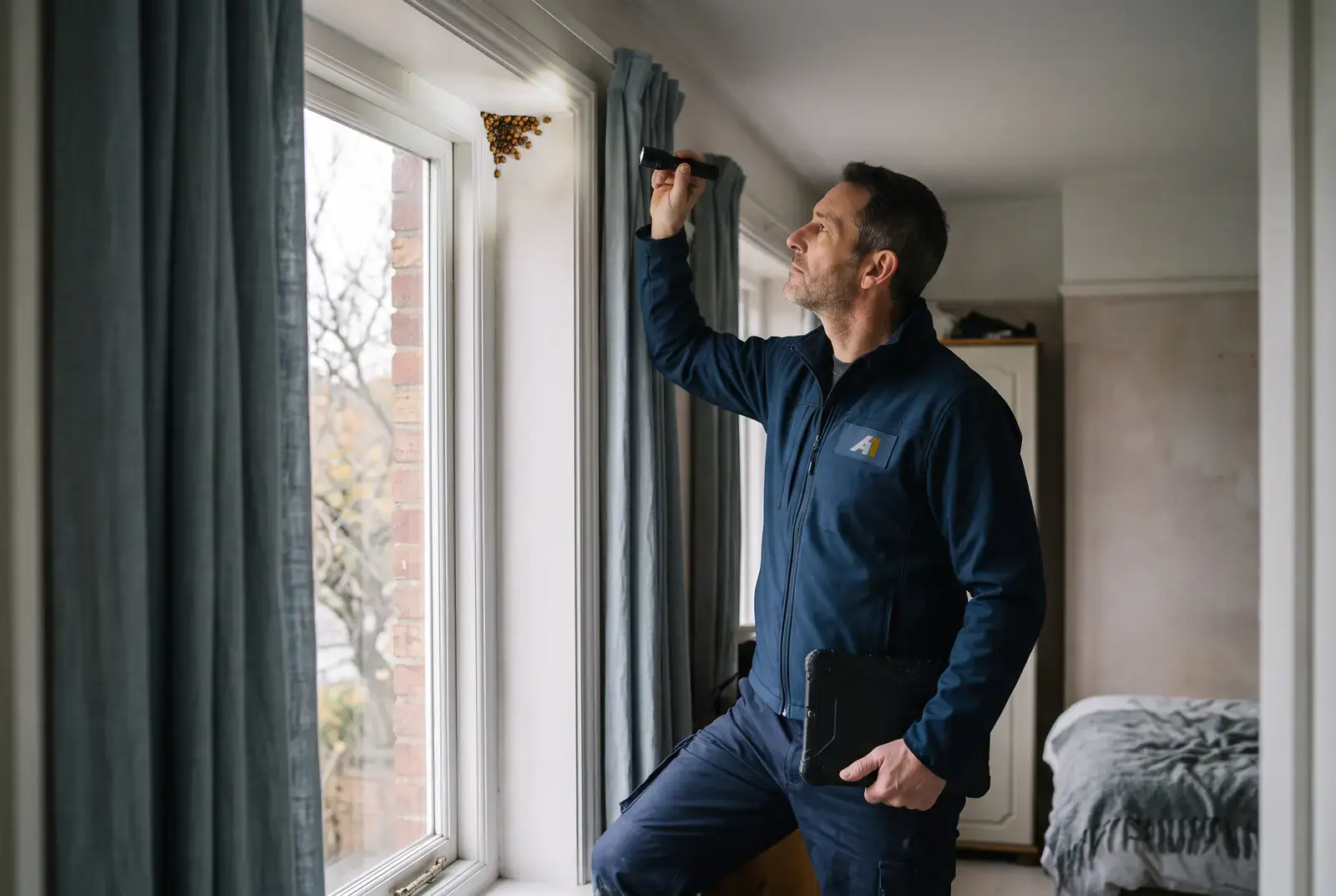
Ladybird removal in Locks Heath
Within 5 km of Locks Heath, the NBN Atlas (accessed 11 November 2026) lists 105 harlequin ladybird records. The first record is from 2005. Counts peaked at 35 in 2006 and 24 in 2007, then fell to 13 in 2008. November holds the most records, 27. According to the Royal Horticultural Society, adults are 8 to 10 mm long and range from orange with black spots to black with red patches, and they overwinter in groups, often indoors. A1 Pest Control removes those groups from window frames, curtains and loft corners. Technicians go to houses, shops and offices around Locks Heath. Tell us which windows they gather at and whether the loft has any.
About Ladybirds
Ladybirds that crowd into window frames and lofts in autumn are often harlequin ladybirds, a non-native species first recorded in Britain in 2004. They do not damage buildings, but they smell and can stain fabrics when disturbed. A1 Pest Control deals with large groups that come back to homes and businesses each year.
Read the full Ladybirds guideLocal notes for Locks Heath
After the peak the counts were 7 in 2010, 3 in each of 2013 and 2014 and 2 in each of 2016 and 2017, and no year since 2017 has logged more than 3 records. The places named in the records include Hamble and Warsash, with 2 records each. The RHS puts the harlequin’s establishment in Britain at 2004, and the first record in this circle is from 2005. Natural England maps 212 patches of deciduous woodland within 3 km of Locks Heath. The count above is of ladybirds seen, not of buildings affected. For other pests, see the Locks Heath hub.
Local risk in Locks Heath
Unwelcome
Indoors, the problems are numbers, stains and a smell, and outdoors the species eats native ladybirds’ eggs and larvae as well as aphids.
Where groups gather
The sunniest wall draws them first. Check window frames, curtain folds, door surrounds and the corners of the loft beneath sun-facing slopes.
Spraying outside
The RHS advises against it, since native species would suffer too. Inside, a group can be swept up and released outdoors.
Gentle handling
Disturbed ladybirds ooze a yellow, foul-smelling fluid that stains fabric. Collect a group with a soft brush into a pot to keep the mess down.
- Photograph a group before you disturb it.
- Search behind blinds and pelmets.
- Check the loft eaves with a torch where the sun hits the roof.
Our ladybird page helps you separate a harlequin from a native ladybird.
Price and visit times
Tenants in a block of flats should tell the managing agent, so the whole building is treated together. A1 Pest Control takes ladybird calls from Locks Heath homes and businesses on 0800 059 0135.
Starting from £190
Not sure what you have found? Send us a photo first. Evening and weekend visits are available on request, and a weekend visit costs £60 extra.
Request a callCustomer reviews in Locks Heath
Google rating: 5.0 from 6 reviews.