Ladybird removal in Lymington
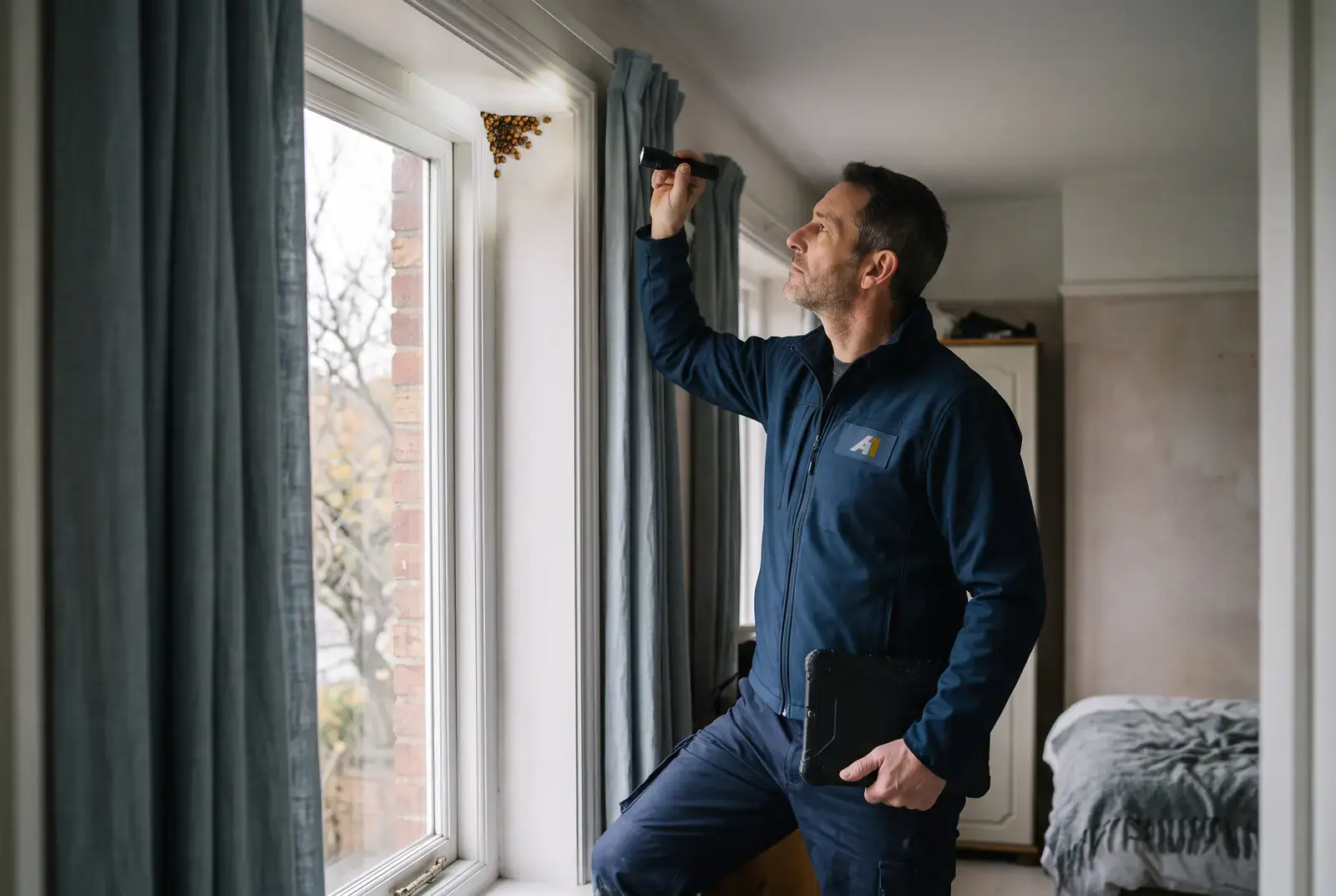
A1 Pest Control technicians carry out ladybird removal in Lymington, SO41, starting from £190. Of the 44 recorded harlequin ladybird sightings within 5 km of Lymington on the NBN Atlas, accessed 12 November 2026, 34 date from the five years 2006 to 2010, with 14 in 2006, the year of the first record. The Royal Horticultural Society says the harlequin came from Japan, was not deliberately introduced to Britain, and became established in 2004. In autumn, the sign most often seen is a group on a sunny window. Those groups are removed from homes, shops, pubs and offices. A technician goes to the address you give us in Lymington. Do any groups gather at particular windows or in the loft?
About Ladybirds
Ladybirds that crowd into window frames and lofts in autumn are often harlequin ladybirds, a non-native species first recorded in Britain in 2004. They do not damage buildings, but they smell and can stain fabrics when disturbed. A1 Pest Control deals with large groups that come back to homes and businesses each year.
Read the full Ladybirds guideLocal notes for Lymington
Counts for the years after 2006 were 6 in 2007, 7 in 2008, 3 in 2009 and 4 in 2010, with a further 8 sightings dated 2014 onwards. November is the busiest month, with 15, ahead of October on 12, March on 5 and September on 4, and those three autumn months together hold 31 of the 44. Records from the Ladybird Survey of the UK number 34, and those from iRecord 10. The first Lymington record came two years after establishment. The records count sightings of ladybirds, not the homes that have them. Our Lymington pest control page is where the other pests we treat are listed.
Local risk in Lymington
An import that spread
The society says the species was released as an aphid control in other countries and has since become widespread in England. Scale insects, and the eggs and larvae of butterflies, moths and other ladybirds, are taken as well, though aphids are its main food.
Spotting a harlequin
The commonest forms of the adult, which is 8 to 10 mm long, are black with two red spots or orange with 18 black spots. Larvae are charcoal grey and spiky with two orange stripes, up to about 1 cm, and they are cannibalistic. The pupae are about 8 mm across and stay fixed to a plant. The ladybird page has photographs of each.
Overwintering
Groups shelter indoors over winter, and a few in a house do no harm to people.
- Look at window frames on the sunny side.
- Check curtain folds and loft eaves.
- Photograph a group for the UK ladybird survey.
Price and visit times
A tenant should report a group on a communal wall or roof to the landlord, who arranges work on shared parts of the building. Ring 0800 059 0135 to make a Lymington booking.
Starting from £190
Not sure what you have found? Send us a photo first. Evening and weekend visits are available on request, and a weekend visit costs £60 extra.
Request a callCustomer reviews in Lymington
Google rating: 5.0 from 6 reviews.