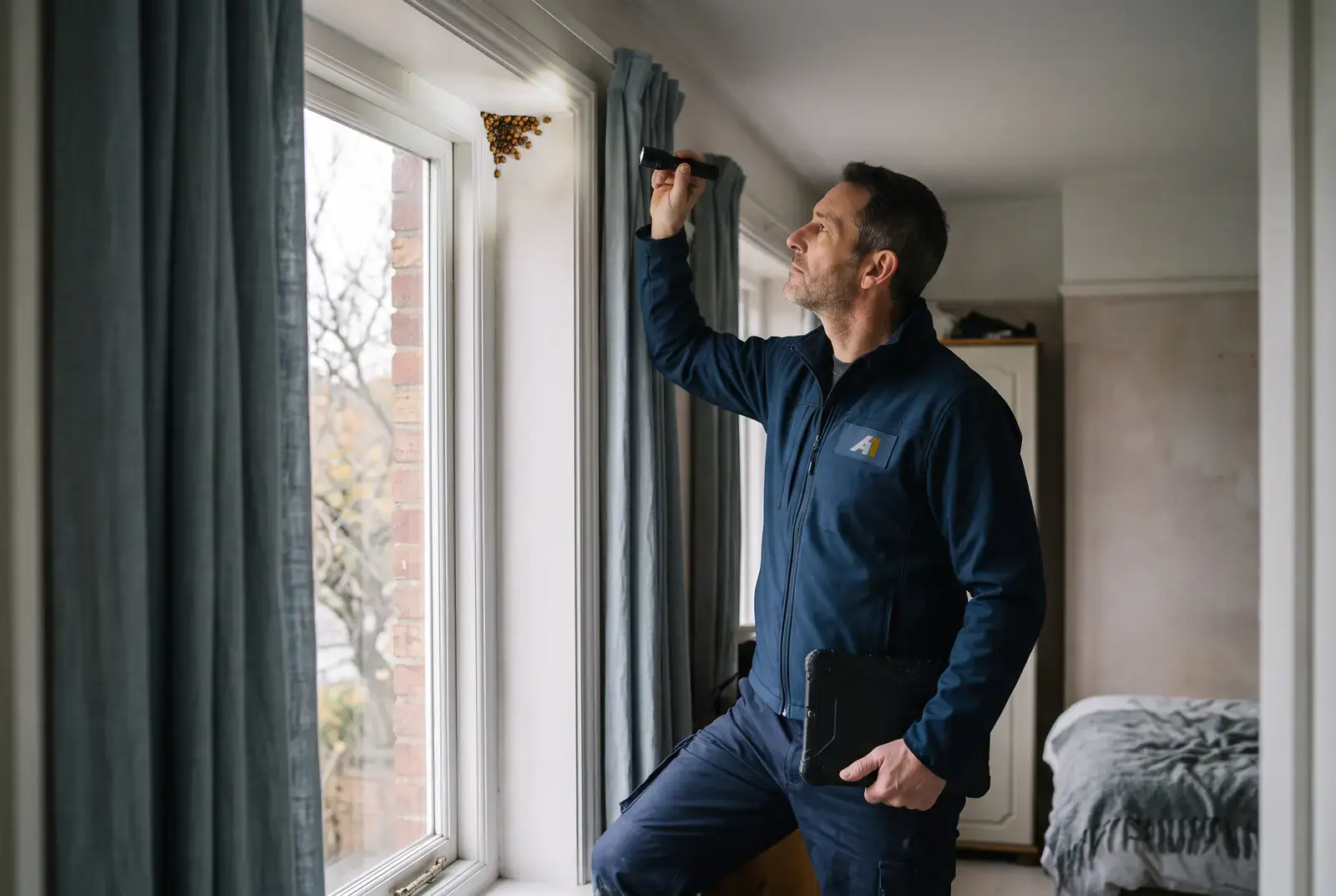
Ladybird removal in Cowes
Starting from £190, A1 Pest Control provides ladybird removal in Cowes, PO31 and PO32. Winter groups are cleared from window frames, curtain folds and loft corners. Within a 5 km circle around Cowes, the NBN Atlas, accessed 12 November 2026, holds 20 recorded harlequin ladybird sightings on the Isle of Wight side; the first is from 2011, and no year goes above 3. Records from the Hampshire shore, which the circle also takes in, are left out. Harlequins overwinter in houses, the Royal Horticultural Society says, and adults range from black with two red spots to orange with 18 black spots at 8 to 10 mm. Our technicians visit homes, shops and offices across Cowes. Say which windows the groups gather at.
About Ladybirds
Ladybirds that crowd into window frames and lofts in autumn are often harlequin ladybirds, a non-native species first recorded in Britain in 2004. They do not damage buildings, but they smell and can stain fabrics when disturbed. A1 Pest Control deals with large groups that come back to homes and businesses each year.
Read the full Ladybirds guideLocal notes for Cowes
Year by year, 2011 has 1, 2013 has 3, 2015 has 2, 2016 has 1, 2017 has 2, 2018 has 2, 2020 has 1, 2021 has 2, 2023 has 1, 2024 has 1, 2025 has 2 and 2026 has 2. Of the 20, 4 fall in October, the busiest month. A single sighting each is all that 2011, 2016, 2020, 2023 and 2024 hold, against the peak of 3 in 2013. Seven years after the 2004 date the RHS gives for the harlequin’s establishment in Britain came the first Cowes record. Buildings with groups indoors are not what these entries count; each is a sighting of a ladybird. For the other pests we treat, see the Cowes hub.
Local risk in Cowes
Why they come indoors
The RHS says the harlequin is predatory, with a taste for aphids, and that it arrived in Britain unaided rather than by deliberate release. It overwinters in groups, sometimes inside houses. Adults look for a dry crack as autumn cools.
Harlequin or native
Native ladybirds vary in colour too. Size is the easiest way to tell a harlequin, at 8 to 10 mm, from the two-spot and ten-spot ladybirds, which the RHS notes measure 4 to 5 mm.
Clearing a group
The building takes no damage from a winter group. Sweep it gently into a pot with a soft brush and release the ladybirds outside, since a startled one leaves a stain on fabric.
- On sunny windows, look behind blinds and pelmets.
- Look along loft eaves under south-facing slopes.
- Before moving a group, photograph it.
To tell a harlequin from a native species, use our ladybird page.
Price and visit times
Dealing with the whole building at once depends on the landlord, so a tenant with a group on a shared wall or a communal roof should tell them. Cowes homes and businesses can book ladybird visits from A1 Pest Control on 0800 059 0135.
Starting from £190
Not sure what you have found? Send us a photo first. Evening and weekend visits are available on request, and a weekend visit costs £60 extra.
Request a callCustomer reviews in Cowes
Google rating: 5.0 from 6 reviews.