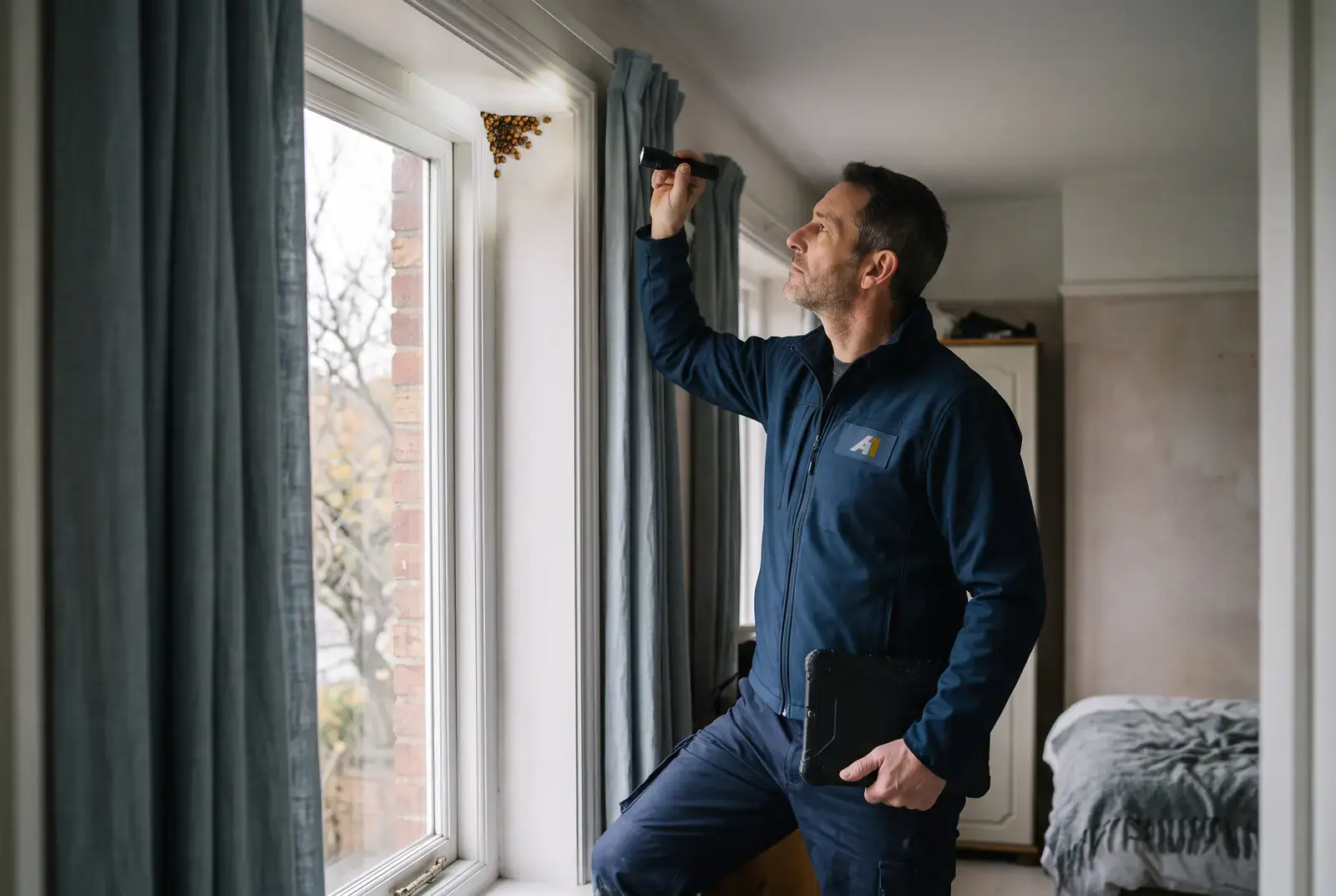
Ladybird removal in Barnham
The NBN Atlas, accessed 11 November 2026, holds 46 recorded harlequin ladybird sightings within 5 km of Barnham. The first dates from 2006, and both 2006 and 2007 hold 13, while the other 20 are spread across 2008 to 2026. The Royal Horticultural Society says harlequins overwinter in sheltered places, often in large groups inside buildings, and that groups show most on the south side of a building. A cluster in a window frame, a curtain fold or a loft corner on a mild winter day is often harlequins. A1 Pest Control deals with groups that come back to the same house each year. Technicians visit windows and roof spaces across the village of Barnham. Tell us which windows they use, and which month they arrive.
About Ladybirds
Ladybirds that crowd into window frames and lofts in autumn are often harlequin ladybirds, a non-native species first recorded in Britain in 2004. They do not damage buildings, but they smell and can stain fabrics when disturbed. A1 Pest Control deals with large groups that come back to homes and businesses each year.
Read the full Ladybirds guideLocal notes for Barnham
The RHS says the harlequin became established in Britain in 2004, so the 2006 sighting near Barnham came within two years. July has the most sightings, with 11, then November with 10, and autumn is when the RHS says adults seek winter shelter. August and May have 5 each.
The 46 sightings come from three sources: 31 from the Ladybird Survey of the UK, 12 from iRecord and 3 from Sussex beetle records up to 2017. The sightings fall across 13 separate years between 2006 and 2026, and recent years hold 3 in 2025 and 1 so far in 2026. See our Barnham pest control hub for the other pests we treat.
Local risk in Barnham
Stains and smell
A disturbed harlequin can exude a clear yellow liquid that may stain furnishings. An adult runs from 8 to 10 mm and ranges from black with two red spots to orange with 18 black spots.
Native ladybirds look alike
The native two-spot and ten-spot ladybirds are smaller, at 4 to 5 mm, and also come in many colour forms. A technician checks the species before treating a group.
Clearing a cluster
On a mild day, brush a cluster into a tub and carry it outdoors. Gaps round window frames and under the eaves are where they get in.
- Inspect the sunniest windows before the rest.
- Never crush a cluster on curtains or sofas.
- Photograph a few for identification.
- Fill gaps at the eaves before October.
- Vacuum stragglers and empty the bag outdoors.
Our ladybird guide shows how to tell the species apart.
Price and visit times
Arun District Council does not list ladybirds, so a winter group in a Barnham house is a private job. A1 deals with ladybird groups across the village on 0800 059 0135.
Starting from £190
Not sure what you have found? Send us a photo first. Evening and weekend visits are available on request, and a weekend visit costs £60 extra.
Request a callCustomer reviews in Barnham
Google rating: 5.0 from 6 reviews.