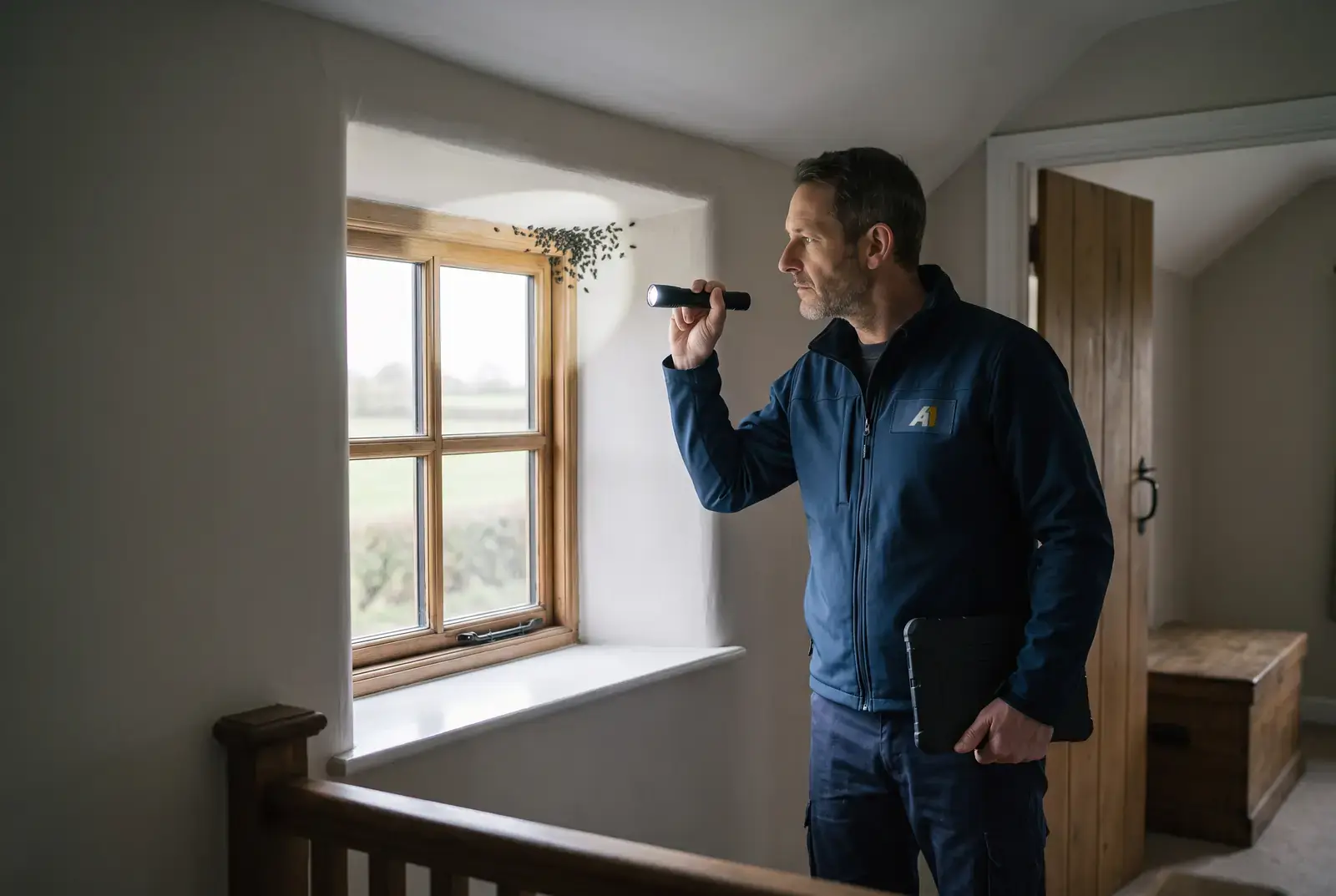
Cluster fly control in Locks Heath
Cluster flies are slow, dark grey flies that breed outdoors and move into buildings in autumn, often settling in lofts and at warm windows. Natural England maps 18 patches of floodplain grazing marsh, 39.0 ha in all, within 3 km of Locks Heath, and 89 patches, 224.0 ha, within 5 km. The BPCA says the larvae of one species live on earthworms, so the flies arrive from outside and are no sign of dirt indoors. A1 Pest Control treats the flies that have settled in lofts and at window frames. Our technicians visit homes and businesses across the Locks Heath area. Tell us which rooms they are in and whether they are moving or dead.
About Cluster flies
Cluster flies are slow, dark grey flies, a little larger than a house fly, that gather in lofts, upper rooms and window frames in autumn to spend the winter. They breed outdoors and are not known to cause illness, but thousands can build up in one roof space. A1 Pest Control treats cluster flies in homes and businesses.
Read the full Cluster flies guideLocal notes for Locks Heath
Warsash Common has four conserved grassland areas beside young woodland, ancient wet woodland in its stream valleys, ponds and two streams, and Hook Lake lies where those valleys end. Natural England also maps 8 patches of lowland meadow, 5.9 ha, within 5 km. Natural England’s reserve layer gives Hook with Warsash Local Nature Reserve, on the coast at Warsash, 251.6 ha. The NBN Atlas, accessed 11 November 2026, holds two Pollenia records within 5 km, the genus of the cluster fly, one from 2024 labelled Warsash, and both are recorded at genus level only. Pests beyond flies are covered on the Locks Heath hub.
Local risk in Locks Heath
How they get inside
The BPCA says cluster flies are not filth flies; the trouble is how many collect in one spot. Thousands can pack into a roof space and gather on the sunny side of a house on mild afternoons.
Return visits
Flies that find a good spot tend to return to it, and a loft that had them once is likely to have them again. A fly that wakes on a warm winter day bumps against windows and drops to the sill.
Sorting them from house flies
A cluster fly is darker and a little larger than a house fly, flies more slowly and folds its wings over one another at rest. Fine golden hairs behind the head rub off with age.
- Vacuum dead flies from sills and loft floors, and empty the bag outside.
- Fit fine mesh over vents and gaps at the eaves.
- Check window frames in the upper rooms in early autumn.
Our cluster fly guide explains the life cycle.
Price and visit times
Starting from £200
Not sure what you have found? Send us a photo first. Evening and weekend visits are available on request, and a weekend visit costs £60 extra.
Request a callCustomer reviews in Locks Heath
Google rating: 5.0 from 6 reviews.