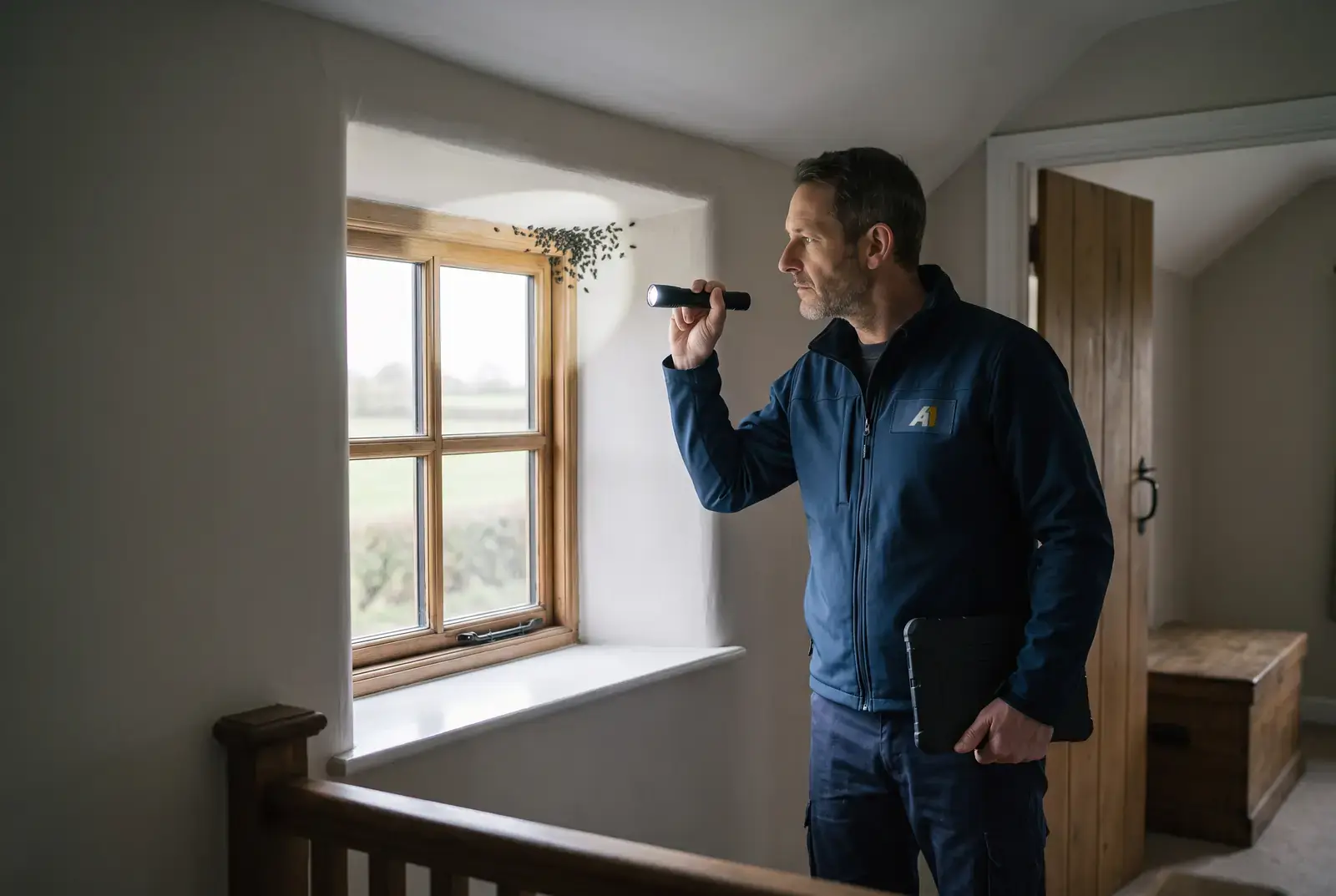
Cluster fly control in Hedge End
In autumn cluster flies move into roofs, having bred outdoors, and Hedge End has a meadow in its middle. Coltsfoot Paddock is a wildflower meadow inside Wildern Local Nature Reserve, and the Town Council’s 2019 Pollinator Action Plan says two Dexter cattle graze it for conservation for 3 to 4 months of the year, quoting the county ecologist calling it smack in the middle of Hedge End. Within 5 km, the NBN Atlas (accessed 11 November 2026) lists 4 sightings of the genus Pollenia, which includes the cluster fly. A1 Pest Control treats cluster flies in homes and businesses across the town. Say which rooms they fill and when they first arrived.
About Cluster flies
Cluster flies are slow, dark grey flies, a little larger than a house fly, that gather in lofts, upper rooms and window frames in autumn to spend the winter. They breed outdoors and are not known to cause illness, but thousands can build up in one roof space. A1 Pest Control treats cluster flies in homes and businesses.
Read the full Cluster flies guideLocal notes for Hedge End
Wildern Local Nature Reserve is the label on all 4 Pollenia sightings, which date from 2022, 2023 and 2024, two of them from 2024. About 9.7 hectares make up the reserve, with ponds, two spring-fed brooks, flooded meadows and a valley mire, and the paddock sits inside it. The grazing is recorded in the 2019 plan, written by the Town Council, which looks after most public open space in Hedge End. Within 3 km, Natural England maps 16 patches of floodplain grazing marsh, 24 hectares in all, and 6 patches of lowland meadow, 4.5 hectares in all. The town hub has more about pest control in Hedge End.
Local risk in Hedge End
Grass, worms and flies
Certain earthworms are where the larvae of one cluster fly species live, the BPCA says, which makes that species more common in rural areas. Adults gather in upper rooms and roof spaces in autumn to hibernate.
Returning each year
According to the BPCA, cluster flies pick a building and may come back to it the following autumn, and a vacuum cleaner is often the easiest way to clear a room of them.
- Rather than crushing sluggish flies, vacuum them from windows.
- In summer, close gaps round eaves and roof windows.
- As the weather cools, inspect loft edges and upper windows.
- Sweep dead flies off sills and loft boards.
- Write down the date of the first flies you see and the room they fill.
- Photograph a few flies on a sill so the species can be confirmed.
- Look for bats before anything goes into a loft, as bats and their roosts are protected.
The flies are traced from field to loft in our cluster fly guide.
Price and visit times
Cluster flies in Hedge End do not bring a council visit. The Eastleigh page on verminous premises gives no pest control service, so treatment is for the owner or occupier to arrange. Whoever owns the roof should hear from a tenant who finds an autumn cluster in the loft. On 0800 059 0135, A1 books cluster fly visits for houses and businesses.
Starting from £200
Not sure what you have found? Send us a photo first. Evening and weekend visits are available on request, and a weekend visit costs £60 extra.
Request a callCustomer reviews in Hedge End
Google rating: 5.0 from 6 reviews.