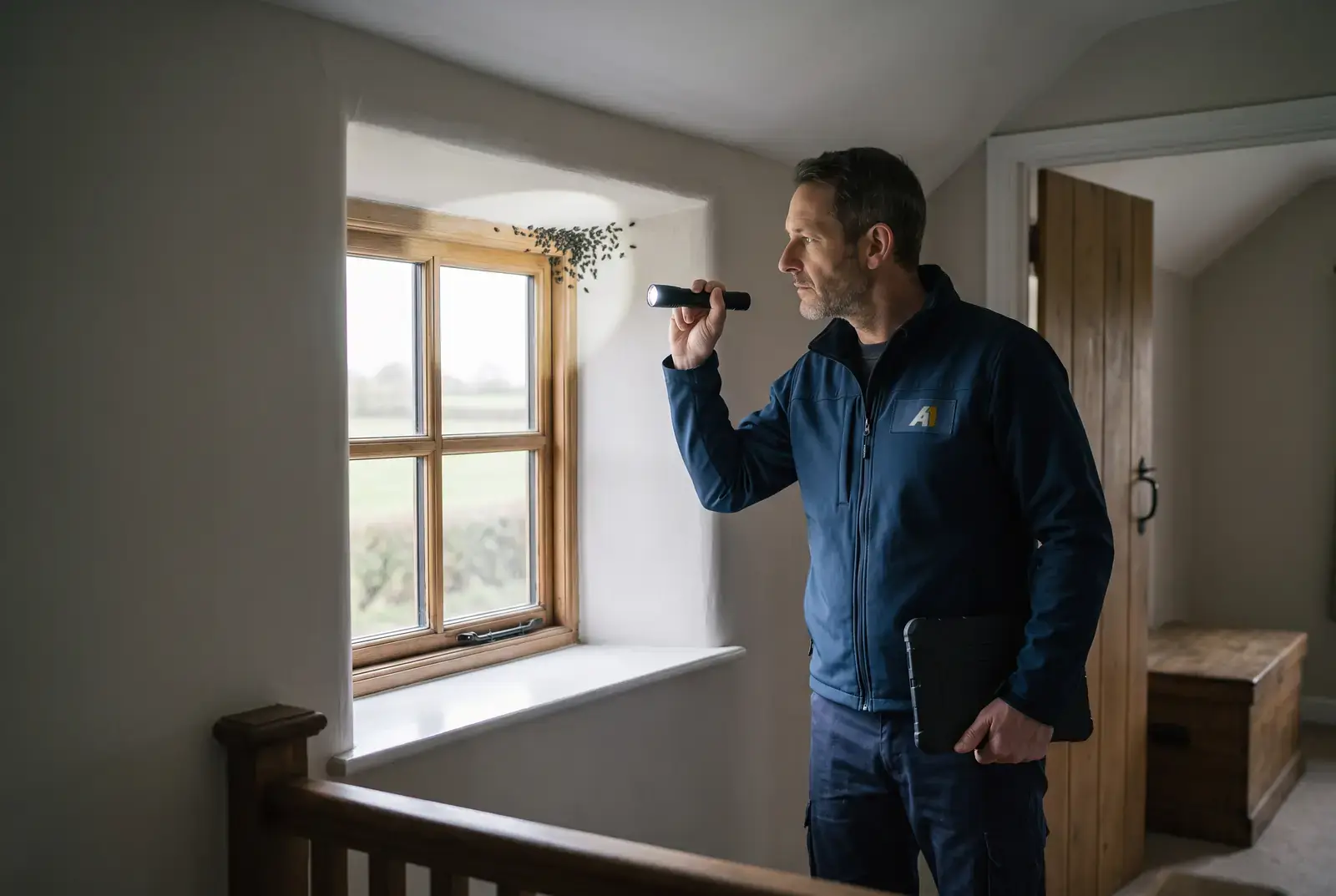
Cluster fly control in Eastbourne
Cotswold District Council’s fact sheet says cluster fly larvae are parasites of earthworms in field soil, and that houses close to open land see the flies gather on their walls each autumn. Eastbourne Borough Council’s Downland Estate plan puts the estate at about 1,689 ha, with the scarp looking over the urban area of the town. The Joint Nature Conservation Committee describes Pevensey Levels, 3,577.71 ha with Eastbourne as its nearest town, as low-lying grazing meadows. The flies’ arrival is no sign of poor hygiene. A1 Pest Control treats cluster flies in houses, flats and workplaces. A1 Pest Control’s technicians cover the whole of Eastbourne. Tell us which walls and rooms the flies reach, and how many gather on a sunny afternoon.
About Cluster flies
Cluster flies are slow, dark grey flies, a little larger than a house fly, that gather in lofts, upper rooms and window frames in autumn to spend the winter. They breed outdoors and are not known to cause illness, but thousands can build up in one roof space. A1 Pest Control treats cluster flies in homes and businesses.
Read the full Cluster flies guideLocal notes for Eastbourne
The Downland Estate plan splits the estate into 1,199 ha of mainly farmland and a golf course and 490 ha of open public access land. It calls farming integral to maintaining many of the downland habitats, and it weighs cattle grazing against sheep grazing for keeping them in order. Defra’s Countryside Stewardship priorities for the Pevensey Levels character area name floodplain areas around Hampden Park, Langney and Stones Cross as places for new wet grassland. Natural England’s habitat inventory, accessed 11 November 2026, maps 70 patches of coastal and floodplain grazing marsh covering 259.9 ha within 2 km of the town centre, and 341.5 ha within 3 km. Other pests are listed on our Eastbourne pest control hub.
Local risk in Eastbourne
Where cluster flies breed
Cotswold District Council says the larvae live in soil as parasites of earthworms and emerge as adults at the end of summer. The British Pest Control Association adds that the earthworm-parasite species is commoner in rural areas. The flies then look for sheltered gaps, and the sheet names sunny, light-coloured walls as their gathering spots.
Why screens fail
The council’s sheet says fly-screens help little, because the flies squeeze into cracks around tiles and window frames, and that an aerosol in the loft kills only the flies it hits, not those hibernating in crevices. Re-pointing gaps and sealing obvious entry points gives limited help.
Clearing a loft
A vacuum cleaner is the easiest way to remove cluster flies, the association says, with aerosol fly killers for smaller numbers. It adds that a mass of them has a characteristic smell, and the council’s sheet says they tend to return to the same property year after year.
- Check light-coloured walls from mid-afternoon on a sunny autumn day.
- Look at the eaves and fascia boards, where the sheet says they crawl in.
- Empty the vacuum bag outdoors.
Our guide to cluster flies explains how they differ from house flies.
Price and visit times
Starting from £200
Not sure what you have found? Send us a photo first. Evening and weekend visits are available on request, and a weekend visit costs £60 extra.
Request a callCustomer reviews in Eastbourne
Google rating: 5.0 from 6 reviews.