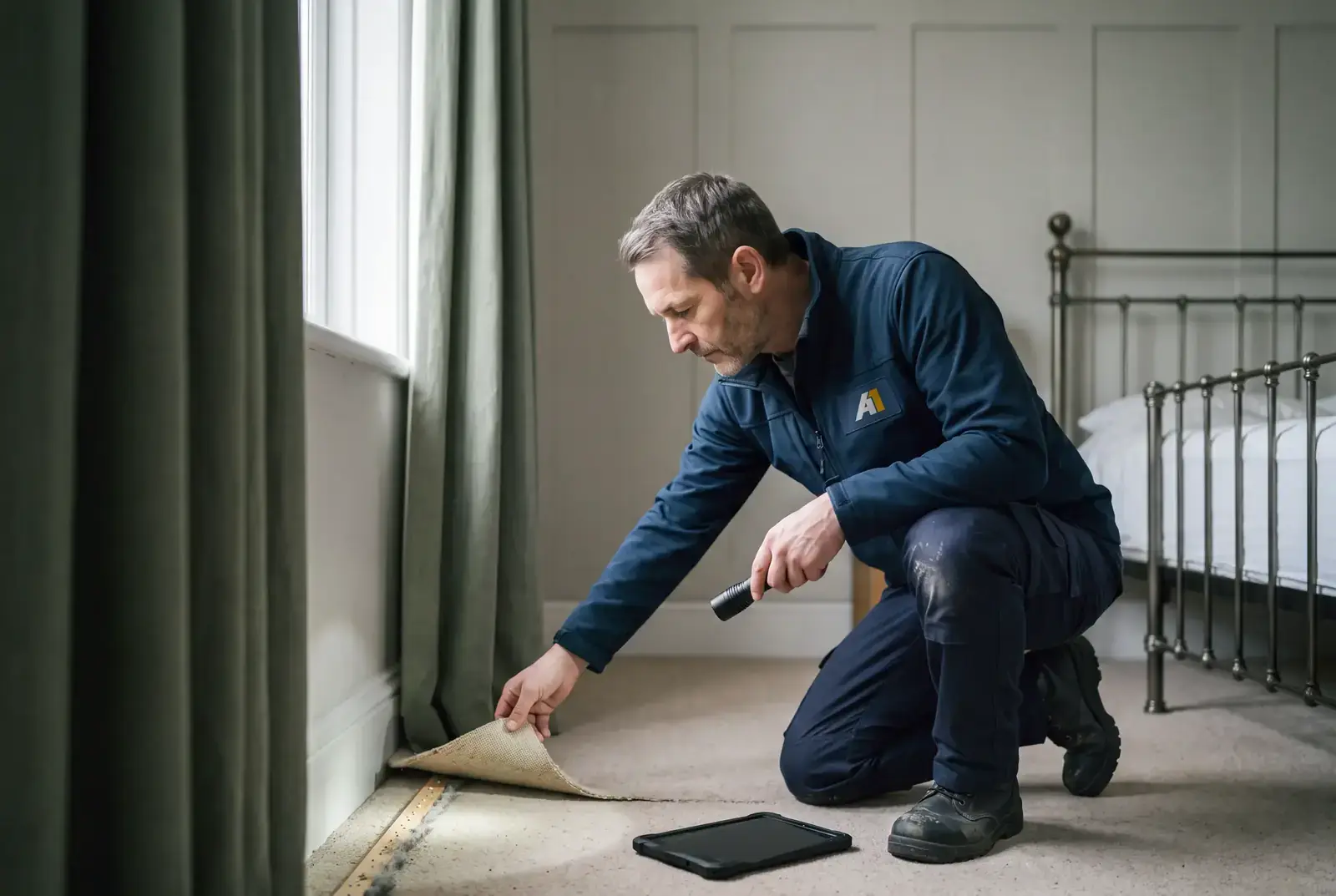
Carpet beetle removal in Southwick
The NBN Atlas, accessed 11 November 2026, holds 621 recorded house sparrow, 767 starling and 530 feral pigeon sightings within 2 km of Southwick. Those are birds seen, not nests found, but the Natural History Museum says carpet beetle larvae turn up in old houses beside birds’ nests. Southwick has 5,220 council-tax dwellings. About 530 of them, 10.2 per cent, were built before 1919, and 38.1 per cent between 1919 and 1944. The larvae, known as woolly bears, are 4 to 4.5 mm long and hairy, and they eat wool, silk, fur and feathers but not synthetic fabric. A1 Pest Control handles carpet beetles in homes, and technicians work across BN42. Describe where the holes appeared.
About Carpet beetles
Carpet beetles show up as small round beetles with a mottled pattern on window sills in spring, and as hairy brown larvae, called woolly bears, in carpets, wardrobes and airing cupboards. The larvae leave small clean holes in wool and natural fabrics. A1 Pest Control treats carpet beetles by finding the source, treating the affected areas and advising on prevention.
Read the full Carpet beetles guideLocal notes for Southwick
Within 2 km the Atlas holds sparrow sightings of 54 in 2015, 30 in 2020 and 69 in 2025. Starling sightings stood at 42 in 2015 and 74 in 2025, and feral pigeon sightings at 30 in 2015 and 68 in 2025. Across 5 km the pigeon count is 5,022, and the circle holds 1 varied carpet beetle, recorded in Hove in 2020. Swift sightings across 5 km peaked at 162 in 2020 and were 94 in 2025. The museum says that species is more common in London and the southern counties. Every other pest we treat in Southwick is listed on the Southwick hub.
Local risk in Southwick
Not moths
Clothes moth damage usually comes with strands of silk webbing, and carpet beetle damage does not: the museum describes small, clean holes with powdery, dust-like droppings and transparent cast skins beside them.
A slow cycle
Larvae need 15 to 25 °C to develop. Outdoors the cycle takes two summers, while indoors the whole thing may finish in a year. Adults live between two and six weeks and, in houses, are often found on windowsills trying to get outside.
Nests and cavities
The museum says nests in roofs are best taken out and destroyed, with the cavities birds favour closed off by wire netting. Wild birds’ active nests are protected, so work waits until the chicks have fledged.
- Vacuum along skirting boards and under heavy furniture.
- Freeze small woollen items in a bag for a day or two at -18 °C.
- Store wool and fur items sealed in thick plastic.
The carpet beetle page shows the adult and the larva.
Price and visit times
The Adur and Worthing website has no advice page on carpet beetles, and the councils treat no pests. A tenant who finds holes in a wardrobe or carpet reports it to the landlord, and Adur Homes treats shared areas only. The council pest control page leaves private treatment to the occupier. A1 books carpet beetle work in Southwick on 0800 059 0135.
Starting from £195
Not sure what you have found? Send us a photo first. Evening and weekend visits are available on request, and a weekend visit costs £60 extra.
Request a callCustomer reviews in Southwick
Google rating: 5.0 from 6 reviews.