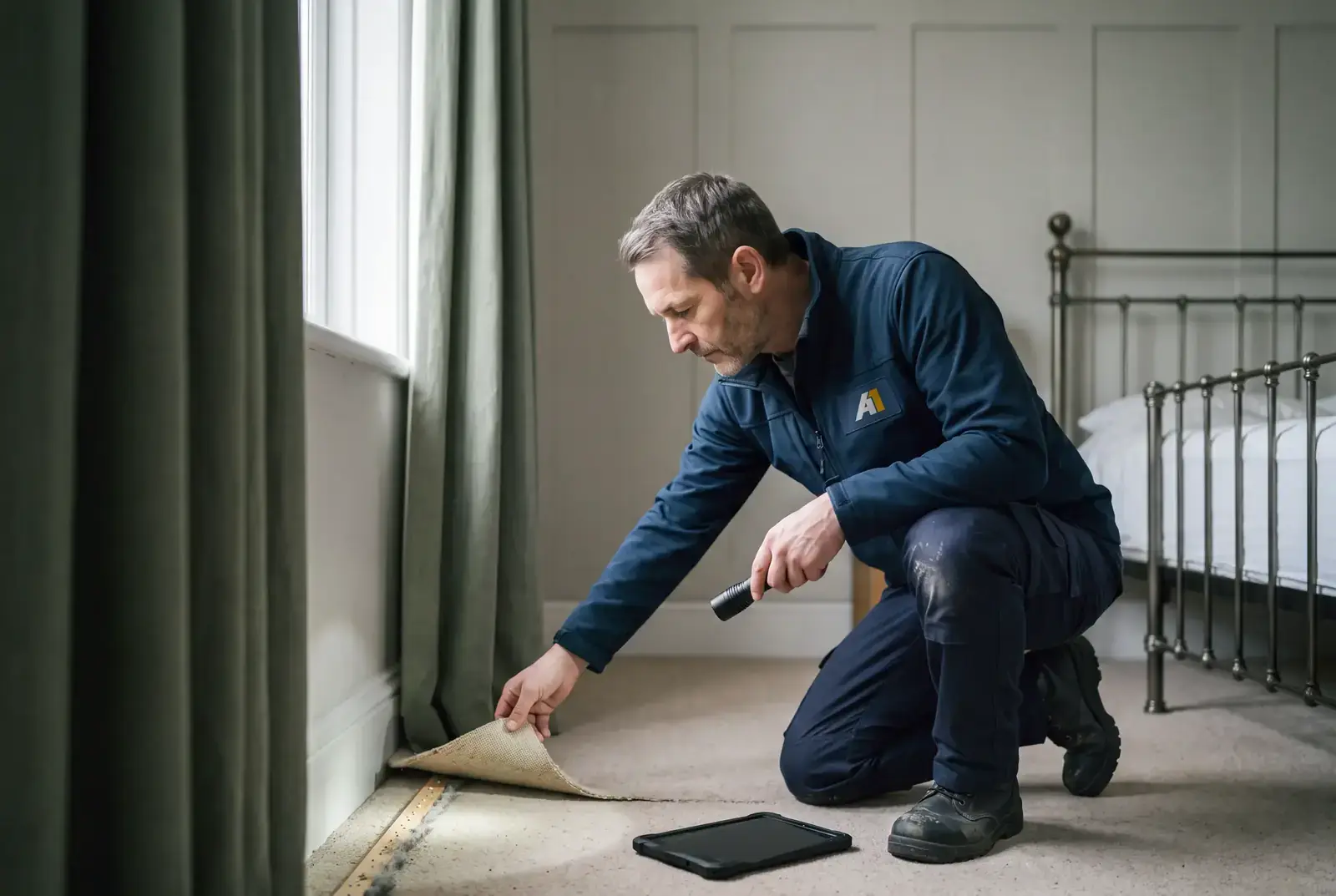
Carpet beetle removal in Derby
Varied carpet beetles turn up in Derby mostly in early summer. The NBN Atlas lists eight sightings within 5 km of the city from 2013 to 2026, two of them in 2026, and five of the eight fall in June. Older homes make up a large share of the city: by the Valuation Office Agency’s count, 19,670 of Derby’s 115,780 homes on the council tax list, 17 per cent, date from before 1919. Because the larvae eat wool, fur, feathers and silk, wool carpets and stored clothes need checking along the skirting and under furniture. A1 Pest Control covers Derby homes, landlords and businesses. Ring 0800 059 0135 with your DE postcode, the rooms affected and what you have found.
About Carpet beetles
Carpet beetles show up as small round beetles with a mottled pattern on window sills in spring, and as hairy brown larvae, called woolly bears, in carpets, wardrobes and airing cupboards. The larvae leave small clean holes in wool and natural fabrics. A1 Pest Control treats carpet beetles by finding the source, treating the affected areas and advising on prevention.
Read the full Carpet beetles guideLocal notes for Derby
Derby is a city of semis and terraces: 39.1% of households live in a semi-detached house and 21.8% in a terrace (ONS Census 2021, TS044). Carpet beetle larvae thrive out of sight behind skirting boards, in carpet pile close to the skirting and in dust between floorboards, and birds’ nests in roofs are important sources (Natural History Museum). In a semi or terrace, check the loft for old nests under the eaves.
The city sits across DE1 and DE21 to DE24, from Abbey, Arboretum and Darley to Normanton, Littleover, Mickleover, Chaddesden and Alvaston.
Local risk in Derby
Records in the city
Oakwood is the one public place named on the beetle records. They are recorded sightings, not infestation levels.
Birds on the buildings
The NBN Atlas holds 6,197 house sparrow records within 5 km, 5,585 starling, 3,010 feral pigeon, 1,009 swift and 332 house martin. In 2025 alone it added 262 house sparrow, 178 feral pigeon, 178 starling and 63 swift records. These are birds, not beetles, but the Natural History Museum lists a bird’s nest in the roof among the main places they come from.
The oldest homes
Of the city’s pre-1919 homes, 16,760 were built before 1900 and 2,910 between 1900 and 1918.
- Lift the edge of a wool rug or carpet in a quiet corner and look for larvae.
- Air and brush stored winter clothes before you put them away.
- Ask a roofer to check the eaves for old nests when other work is done.
Read our carpet beetles page for the treatment, and Derby pest control for the rest.
Price and visit times
Starting from £195
Not sure what you have found? Send us a photo first. Evening and weekend visits are available on request, and a weekend visit costs £60 extra.
Request a callCustomer reviews in Derby
Google rating: 5.0 from 6 reviews.
Your questions, answered.
Can A1 treat carpet beetles for Derby businesses and landlords?
A1 is a private option for businesses and landlords.
I am a landlord in Derby. Who should treat carpet beetles in my property?
A private company can treat them. Tell us how many units are affected, whether tenants are in, and any inspection or check-in dates. We will say whether we can arrange a single treatment or scheduled visits with a written report after each one, which you can keep with the property records.
Which Derby postcodes do you cover?
Derby sits across DE1, DE21, DE22, DE23 and DE24, from the city centre and Arboretum to Darley, Allestree, Mickleover, Littleover, Normanton, Sinfin, Alvaston and Chaddesden. Several districts reach into Amber Valley, Erewash or South Derbyshire. Give us your full postcode first.
When do carpet beetles appear in Derby homes?
The adults emerge in the warmer months, when they feed on pollen, and indoors they often gather on windowsills trying to get out (Natural History Museum). Indoors, the larvae can complete their cycle in a year and need 15 to 25 °C, so a heated house suits them. Larvae can turn up in any season.
What should I check in my Derby home before I call?
Small, clean holes in wool carpets, rugs or clothes with no silk webbing, powdery droppings and transparent cast skins left behind by growing larvae (Natural History Museum). Check under furniture, along the skirting and in stored wool. Keep a larva or a cast skin in a sealed bag and send a photo with your enquiry.